Most DTC brands that struggle with Meta Ads consistency share the same structural problem: they’re running campaigns, not a system. Individual campaigns get tested and optimised in isolation, but there’s no architecture tying prospecting to retargeting, no creative refresh cadence, and no clear signal hierarchy telling the algorithm who to prioritise. The result is erratic ROAS — good months when conditions align, bad months when they don’t.
This post documents the campaign structure framework I use to stabilise Meta Ads performance for DTC brands: from account architecture through audience sequencing to creative governance. It’s drawn from the consistent patterns across accounts where ROAS improved significantly after structural fixes, not from isolated wins.
Editorial note: The framework described here is based on practitioner methodology and repeatable structural patterns. Performance outcomes vary based on product-market fit, creative quality, budget level, and market conditions. All ROAS improvements cited are directional examples of structural impact, not guarantees.
The Root Cause of Inconsistent Meta Ads ROAS
Before fixing structure, it’s worth diagnosing why ROAS is inconsistent. In most accounts I audit, the cause falls into one of three categories:
- Audience overlap and signal competition: Multiple campaigns targeting overlapping audiences compete against each other in auction, driving up internal CPMs. The algorithm fragments its learning across duplicate signals rather than consolidating around the strongest ones.
- Creative fatigue without replacement: The same creative assets continue running past their effective frequency cap. Frequency climbs, CTR drops, CPM rises (Meta shows declining-engagement ads less efficiently), and ROAS falls. There’s no systematic process for identifying and retiring fatigued creatives.
- Missing warm audience infrastructure: The account is prospecting continuously but has no retargeting or warm audience campaigns capturing the intent signals generated by prospecting spend. This is the equivalent of filling a leaking funnel — you acquire intent but don’t convert it.
The Three-Layer Campaign Architecture
The structure that produces consistent ROAS across DTC accounts is a three-layer funnel, each layer with a distinct objective and audience definition:
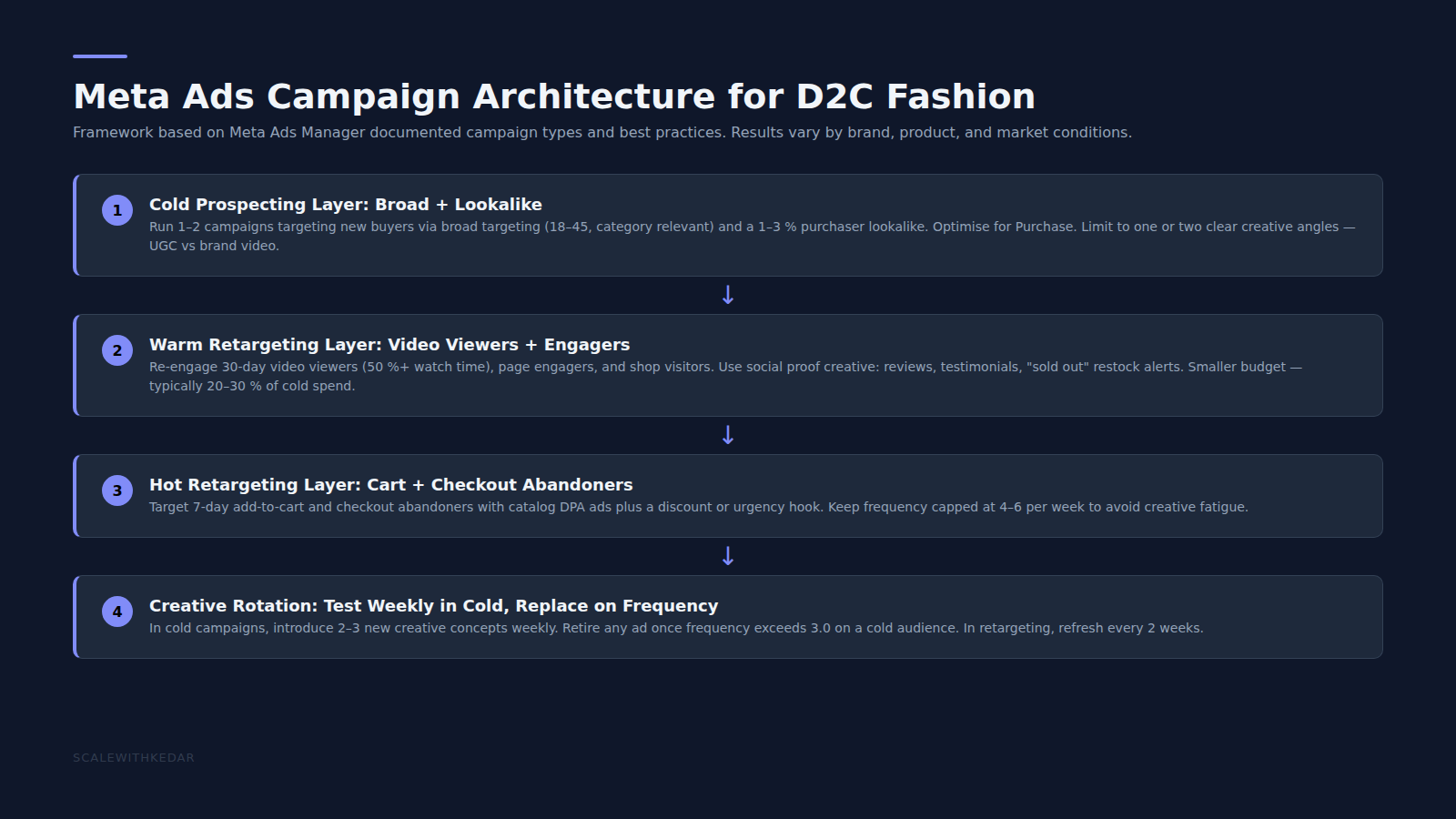
Layer 1: Prospecting (Cold Audiences)
Objective: Reach net-new people who match your ideal customer profile but haven’t interacted with your brand.
Campaign setup:
- Objective: Sales (conversion optimised to Purchase or Add to Cart, depending on volume)
- Audiences: 1–3% Lookalike built from 90-day purchasers + Advantage+ Audiences as a parallel test (see Meta’s Advantage+ Audience documentation)
- Creative: Broad-hook content — problem/solution, before/after, social proof. 3–4 creative variants minimum to give the algorithm rotation options
- Budget: 60–70% of total Meta budget at stable ROAS. Reduce to 50% if retargeting ROAS is significantly stronger
Layer 2: Warm Audience Retargeting (Engaged Non-Purchasers)
Objective: Convert people who’ve shown intent signals — site visits, product page views, add-to-cart — into purchasers.
Campaign setup:
- Objective: Sales (optimised to Purchase)
- Audiences: Website custom audience — Viewed Product / Added to Cart in last 14–30 days, excluding purchasers
- Creative: Testimonial and social proof formats, product-specific dynamic ads (DPA), price-anchored messaging. Keep it to 2–3 creatives; this audience is smaller and fatigues faster
- Budget: 20–30% of total Meta budget. Monitor frequency — above 4x in 7 days on a small audience degrades performance quickly
Layer 3: Retention and Upsell (Existing Customers)
Objective: Reactivate lapsed customers, cross-sell complementary products, and build LTV from the existing customer base.
Campaign setup:
- Objective: Sales
- Audiences: Customer Match list (90–365 day purchasers), segmented by purchase category where possible
- Creative: Loyalty and reward messaging, new product announcements, replenishment reminders for consumables
- Budget: 10–20% of total Meta budget. Often produces the highest ROAS of the three layers because purchase intent is already established
Creative Governance: The Framework That Prevents Fatigue
The three-layer architecture solves the structural problem. Creative governance solves the ongoing operational problem.
The core rule: every creative asset should have a performance review checkpoint at either 7 days or a defined spend threshold (e.g., $200–$500 spent), whichever comes first. At that checkpoint, review:
- CTR (Link): Below 1% on prospecting suggests the hook isn’t working. Below 0.5% is a clear signal to retire or test a new hook variant.
- Cost per initiate checkout or add to cart: Rising week-over-week on the same creative is an early fatigue signal, often before ROAS drops visibly.
- Frequency: Above 3x in 7 days for any retargeting audience means your audience is too small for the budget, or the creative needs refreshing.
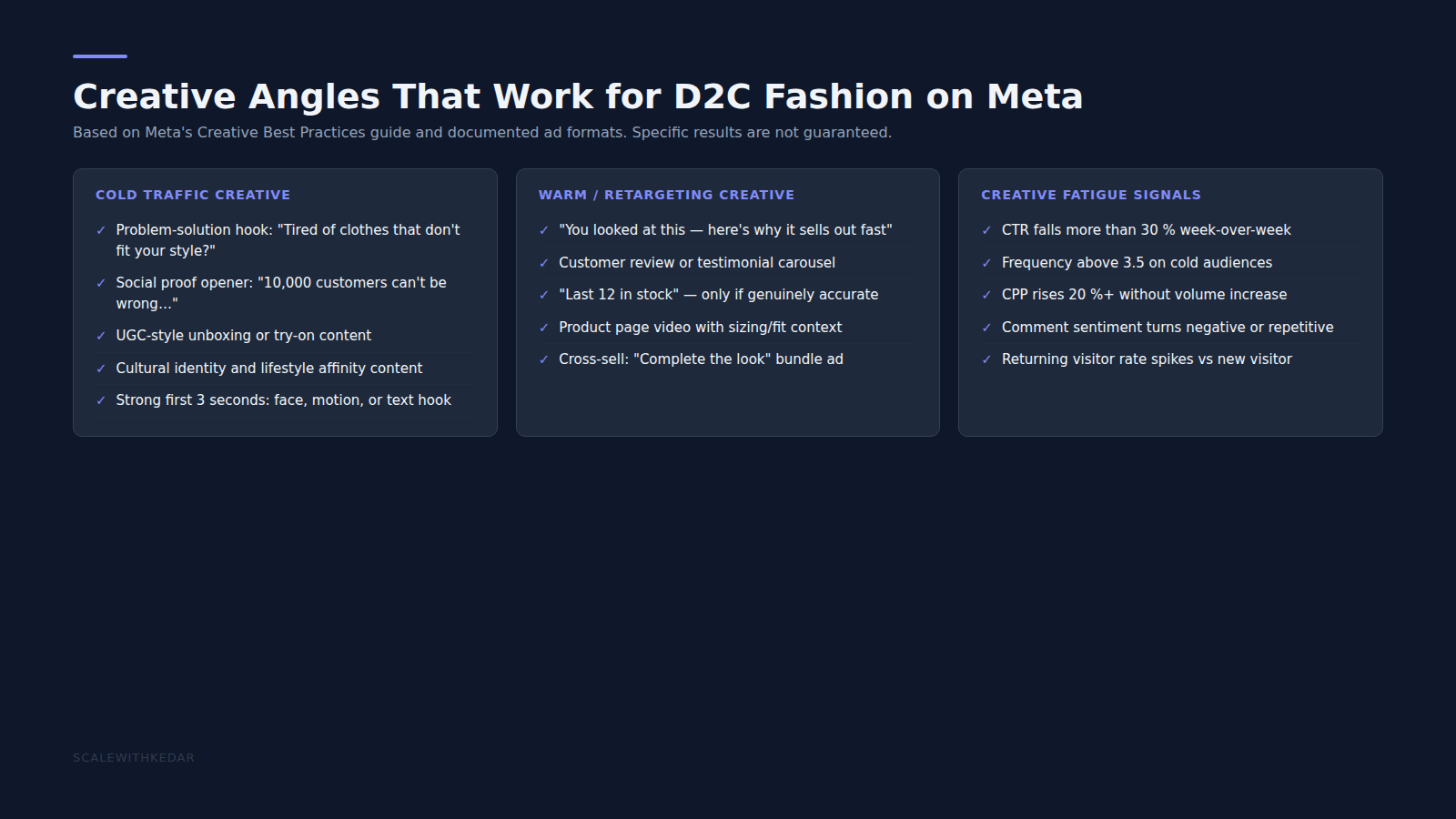
The principle behind this governance is that creative performance on Meta is not stable — it decays. The accounts that maintain consistent ROAS are the ones that refresh creatives on a structured cadence rather than waiting for ROAS to collapse before reacting.
Signal Consolidation: Getting the Algorithm to Work for You
One of the most underrated drivers of Meta Ads performance is signal consolidation. Meta’s algorithm optimises based on the conversion signals you feed it — the more purchase events a campaign sees, the better it optimises. Fragmenting budget across 15 campaigns means each campaign sees fewer events and optimises poorly.
The signal consolidation principles:
- Fewer campaigns, more budget per campaign: Three well-funded campaigns (one per funnel layer) outperform nine underfunded ones. A campaign needs roughly 50 purchase events in a 7-day window to exit the learning phase — below this, algorithm performance is unstable.
- Consolidate creative testing inside campaigns: Use multiple ad sets within a campaign to test audiences, but use A/B testing or creative variants within a single ad set to test creatives. This keeps budget consolidated while still allowing creative learning.
- Use Advantage Campaign Budget (formerly CBO): Let Meta distribute budget dynamically across ad sets within each campaign rather than fixing ad set budgets manually. This improves event accumulation in the best-performing ad sets.
Running scattered Meta campaigns and seeing inconsistent ROAS?
An account audit typically identifies whether the issue is structural (audience overlap, missing warm layer), creative (fatigue, wrong hook for the audience), or tracking (mis-attributed conversions inflating reported ROAS). We return a specific action plan, not a generic report.
Common Structural Mistakes That Suppress ROAS
- Running prospecting and retargeting without audience exclusions: Prospecting campaigns must exclude recent purchasers and retargeting audiences, and vice versa. Without these exclusions, the three layers compete with each other in auction.
- Letting campaigns run indefinitely without creative review: Set a reminder to review creative performance weekly. The biggest ROAS drops come from creative fatigue that goes undetected for 3–4 weeks while spend continues.
- Optimising for the wrong event: If purchase volume is low (under 50/week), optimise for a higher-funnel event like Add to Cart or Initiate Checkout. This gives the algorithm enough signal to optimise while purchase volume builds.
- Ignoring the Delivery Insights tab: Auction overlap, audience saturation, and first-time impression ratio are all available in Delivery Insights. These diagnostics often identify problems before they show up in ROAS.
The brands that build consistent Meta Ads ROAS are the ones that treat the account as an ongoing system to maintain, not a set of campaigns to occasionally check. Structure determines ceiling; creative quality and refresh cadence determine how close you get to it.
For the audience-building layer that feeds this framework, see our guide on Meta Lookalike Audiences for DTC prospecting. For the creative strategy that powers the funnel, see our Meta Ads creative strategy guide.
Sources and Further Reading
- Meta for Business: Advantage+ Audience — official documentation on Advantage+ Audiences and how they integrate with campaign structure.
- Meta for Business: About Lookalike Audiences — source selection and audience size guidance for prospecting campaigns.
- Meta for Business: Campaign Budget Optimisation — how Advantage Campaign Budget distributes spend across ad sets.