Every clinic owner asks the same question in the first conversation: “What should I be paying per lead?” It’s a fair question, and most agencies dodge it. Based on published industry benchmarks and practitioner experience running Meta Ads for healthcare and aesthetic clinic verticals, here are the CPL ranges you should be working from in 2026 — with the context to make them actually useful.
Editorial note: CPL benchmarks vary significantly by market, targeting precision, offer type, and creative quality. The ranges in this guide reflect US healthcare and aesthetic clinic verticals as documented by WordStream’s Healthcare Ads benchmarks and Google’s industry benchmark reports. Treat them as orientation ranges, not guarantees, and measure against your own baseline.
Why Healthcare CPL Is Structurally Higher Than Other Verticals
Healthcare and medical aesthetics consistently produce higher CPLs than most e-commerce or B2B categories. This isn’t a Meta Ads problem — it’s structural:
- Compliance constraints: Meta’s healthcare advertising policies restrict retargeting based on health conditions and limit certain targeting options. This reduces audience efficiency compared to unrestricted verticals. See Meta’s healthcare advertising policy for current restrictions.
- Long decision cycles: Patients researching cosmetic procedures or specialist consultations typically take weeks to convert. A lead captured today may convert in 30–90 days, making short-window attribution misleading.
- High competition for the same queries: Aesthetic clinics, dental practices, and specialist clinics all compete for the same demographic targets, driving up CPMs in major metros.
- HIPAA and compliance sensitivity: For US healthcare advertisers, HIPAA-compliant tracking (avoiding pixel-based tracking of health condition data) further limits optimisation signals available to the algorithm.
CPL Benchmarks by Clinic Type (US Market, 2026)
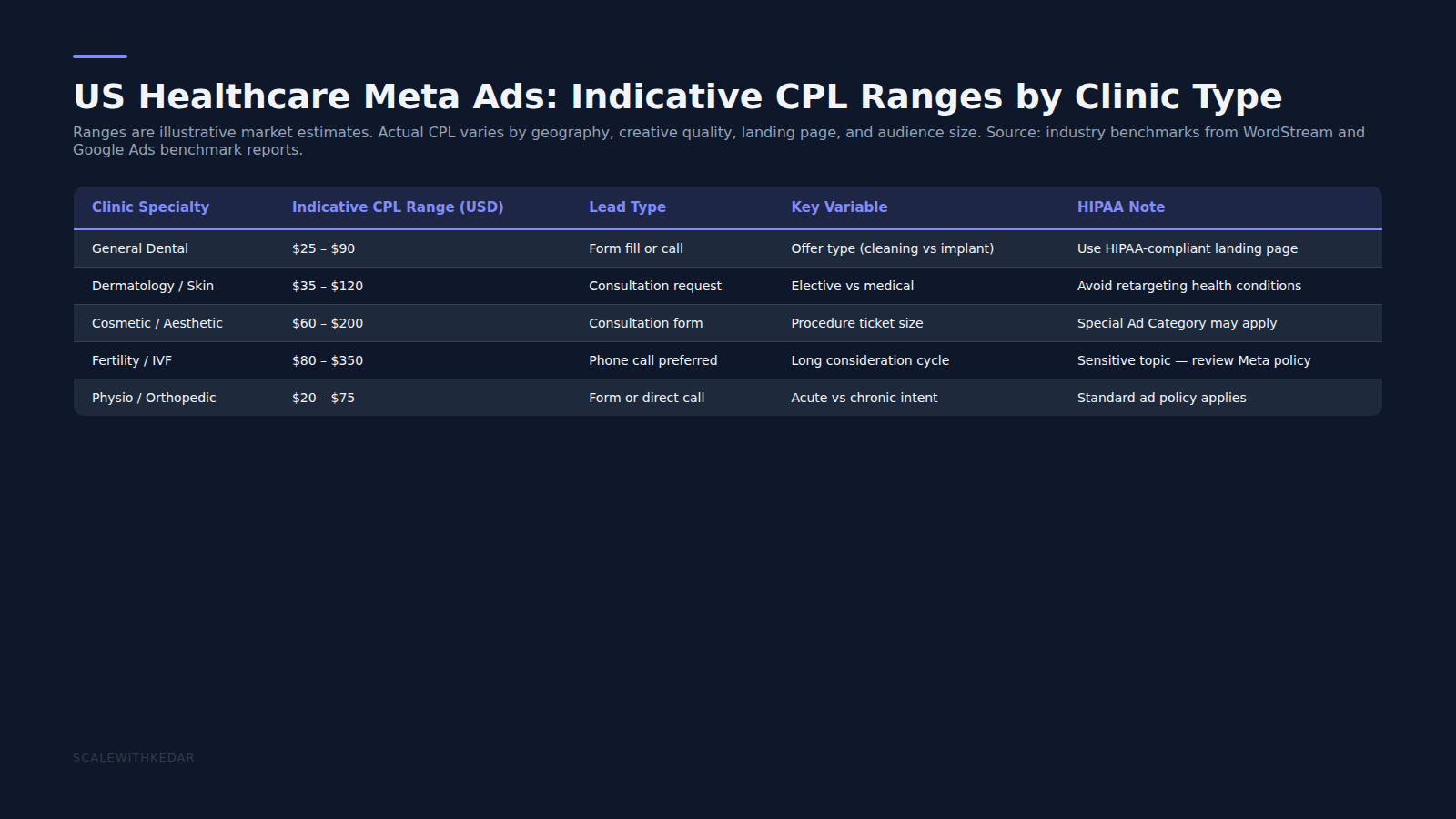
These ranges are drawn from WordStream’s Facebook Ads benchmark data and Google’s healthcare marketing research. They reflect averages across the US healthcare vertical and should be calibrated against your specific clinic type, market size, and offer.
- Aesthetic / cosmetic clinics (Botox, fillers, skin treatments): $25–$80 CPL for consultation bookings via Meta lead forms. Higher-end procedures (lasers, body contouring) skew toward $60–$120 given longer decision cycles.
- Dental clinics (general, cosmetic): $15–$50 CPL for new patient inquiries. Cosmetic dental (veneers, implants) CPLs are higher, typically $45–$90 for qualified leads.
- Specialist medical practices (physiotherapy, fertility, orthopaedics): $30–$90 CPL depending on condition sensitivity and whether Meta’s policies restrict direct targeting in that specialty.
- Wellness and preventive health: $10–$35 CPL for subscription or consultation offers, with lower competition than clinical specialties.
If your CPL is significantly above these ranges and your ad creative and targeting are well-structured, audit three things before concluding the campaign is broken: landing page quality score, lead form completion rate, and whether your conversion is tracking the right event (a form view is not a lead — use the form submission or qualified contact event).
The Three Levers That Move CPL for Healthcare Accounts
1. Lead Form Type vs Landing Page
Meta’s native instant lead forms consistently produce lower CPL than landing page campaigns — but lead quality is often lower. The form pre-fills personal data and reduces friction, which means more people complete it, including people who aren’t genuinely interested.
For high-value procedures where lead quality matters more than volume (e.g., rhinoplasty, IVF consultations), a dedicated landing page with a clear offer often produces fewer but better-qualified leads at a higher CPL. For high-volume, lower-ticket services, native lead forms typically give better economics.
Test both approaches for your highest-priority service, using the same ad creative and audience, and measure cost-per-qualified-lead (not raw CPL) after your team has followed up with each batch.
2. Offer Structure
The offer framing has a significant impact on CPL and lead quality. In healthcare, the highest-converting offers tend to be:
- Free consultation / assessment: Low barrier, high volume. Works best when your conversion from consultation to booking is strong (above 30%).
- Limited-time pricing or package offers: Creates urgency. Works for aesthetic procedures where price sensitivity is a real factor. Must comply with Meta’s promotional policies.
- Educational lead magnets: “Download our guide to [procedure]” produces soft leads that need nurturing but can work well for high-consideration procedures where education precedes purchase intent.
3. Audience Structure
Healthcare advertisers typically see the most CPL improvement from tightening audience relevance rather than broadening reach. The most productive targeting approaches:
- Interest-based targeting around life events and health awareness: Audiences interested in specific health outcomes (not conditions) combined with age and demographic overlays.
- Lookalike audiences built from existing patients: If your CRM holds at least 500+ clean patient records, a 1–3% lookalike built from this list typically outperforms broad interest targeting for established clinics.
- Geographic radius tightening: Most clinic patients come from within 10–15 miles. Running broad geographic targeting inflates impressions and CPL without improving lead quality. Set a realistic radius around each clinic location.
Lead Quality: The Metric That Actually Matters
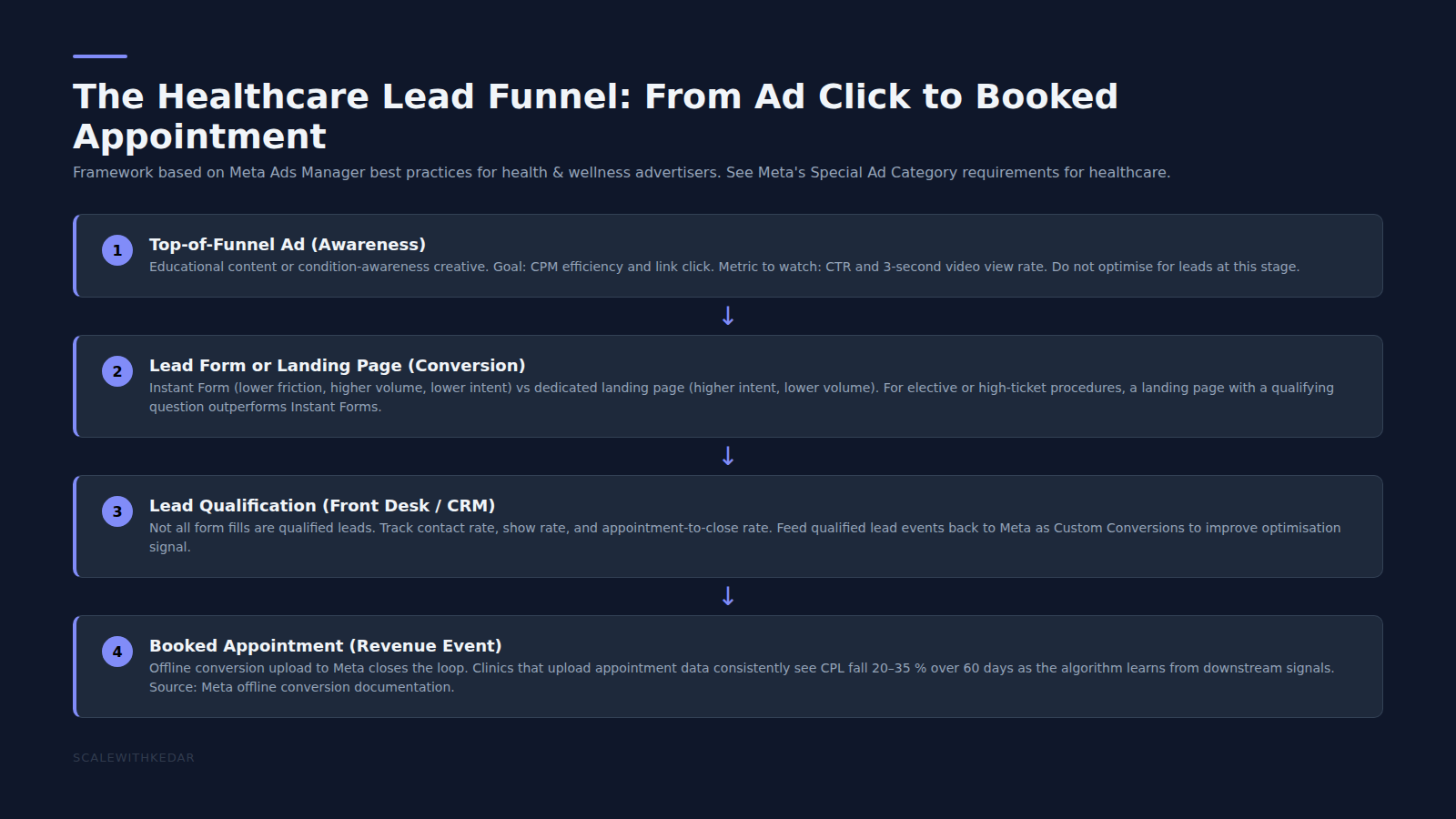
CPL is a proxy metric. What clinic owners and practice managers actually care about is cost-per-booked-appointment and ultimately cost-per-treatment. A $20 CPL that produces 2% show rate is worse economics than a $60 CPL that produces 40% show rate.
Build a conversion tracking system that follows leads through the full funnel:
- Lead captured (form submission or landing page conversion)
- Lead contacted (outbound call or message)
- Consultation booked
- Consultation attended (show rate)
- Treatment booked
With this data, you can calculate actual cost-per-acquired-patient and make decisions about whether higher CPL is worth the lead quality trade-off. Without it, you’re optimising for a metric that doesn’t directly reflect revenue.
Running healthcare Meta Ads but not sure if your CPL is competitive?
A structured audit of your healthcare account will benchmark your CPL against vertical norms and identify the specific structural issues — audience, creative, or tracking — driving above-average cost per lead.
HIPAA Compliance Considerations for US Healthcare Advertisers
US healthcare advertisers face additional constraints beyond Meta’s advertising policies. The key compliance points affecting Meta Ads specifically:
- Avoid retargeting based on health condition data: Do not use the Meta pixel to create custom audiences from pages where health conditions are identifiable (e.g., a page for a specific diagnosis or condition treatment). This is a HIPAA risk area where pixel data could constitute Protected Health Information (PHI).
- Use HIPAA-compliant analytics alternatives: Server-side event tracking that strips PHI before sending to Meta is the recommended approach for healthcare advertisers. Consult your compliance team before implementing.
- Lead form data handling: Meta Lead Ads data collected through instant forms must be handled in compliance with your practice’s data handling policies. Ensure your CRM integration is compliant before enabling lead sync.
For current guidance, refer to the HHS guidance on PHI use and disclosures and consult qualified healthcare compliance counsel for your specific situation.
For the paid media frameworks that underpin effective healthcare acquisition campaigns, see our guide on building Meta Lookalike Audiences from patient lists and our Meta Ads creative strategy guide for building compliant ad creative in regulated verticals.
Sources and Further Reading
- WordStream: Facebook Ads Benchmarks by Industry — includes healthcare CPL averages and CTR benchmarks across verticals.
- Think with Google: Healthcare Marketing Trends — Google’s research on healthcare consumer behaviour and digital touchpoints.
- Meta Advertising Policies: Healthcare and Medicines — official policy for healthcare advertising on Meta platforms.
- HHS: HIPAA Guidance on PHI Use and Disclosures — federal guidance relevant to US healthcare advertisers using digital marketing tools.