If you’re running a D2C brand in India, you’ve probably felt this pinch: your ads are getting more expensive, your cost per click is climbing, and somehow, every new customer seems to cost more to acquire than they did just six months ago. Your customer acquisition cost — or CAC — is quietly eating into your margins, and it feels like there’s no end in sight.
Here’s the reality: India’s D2C ecosystem is maturing fast. More brands are competing for the same eyeballs on Meta and Google, ad costs have risen significantly, and the era of cheap paid traffic is over. But the brands that are winning in 2026 aren’t just spending more — they’re spending smarter, building systems that bring CAC down sustainably over time.
This playbook breaks down exactly how to do that.

What Is Customer Acquisition Cost and Why It Matters So Much
CAC is straightforward: it’s the total amount you spend to acquire one new paying customer. The formula is:
CAC = Total Marketing and Sales Spend ÷ Number of New Customers Acquired
If you spent ₹1,00,000 on ads last month and acquired 200 new customers, your CAC is ₹500. Whether that number is healthy depends entirely on your average order value (AOV) and customer lifetime value (LTV).
A profitable D2C business typically targets a CAC-to-LTV ratio of at least 1:3. So if your CAC is ₹500, your LTV should ideally be ₹1,500 or more. If it isn’t, you’re in a slow bleed situation — and the faster you scale, the faster you burn cash.
Why Indian D2C Brands Are Struggling With High CAC in 2026
There are a few structural reasons why acquisition costs are under pressure right now:
- More competition on paid channels: The D2C boom put hundreds of new brands onto Meta and Google simultaneously. More bidders means higher CPMs and CPCs across almost every category.
- iOS privacy changes still hurting attribution: Apple’s App Tracking Transparency (ATT) framework continues to affect how Meta tracks and reports conversions. Many brands are actually performing better than their dashboards suggest — but they don’t know it.
- COD dependency: A large share of Indian D2C orders are still cash-on-delivery, which drives up return rates and operational costs — both of which inflate your true CAC beyond what ads alone show.
- Weak landing pages: Many brands are paying to send traffic to poorly optimised product pages that convert at 1% or less. The difference between a 1% and a 3% conversion rate can literally triple your CAC without changing your ad spend by a single rupee.
6 Proven Strategies to Lower Your CAC in 2026
1. Fix Your Conversion Rate Before You Scale Ad Spend
This is the single highest-leverage move available to most D2C brands right now. If your website converts at 1% and you push it to 2%, you’ve halved your CAC without changing your budget.
Focus on: a clear value proposition above the fold, strong social proof (real reviews, UGC videos, trust badges), minimal friction at checkout (fewer fields, more payment options), and fast mobile load times. A one-second delay in mobile page speed can reduce conversions by as much as 20% — and most Indian D2C sites are still loading in 4–6 seconds on 4G.
2. Build a Referral Loop Into Your Post-Purchase Flow
Your existing customers are your cheapest acquisition channel, and most D2C brands in India are almost entirely ignoring this lever. A well-designed referral programme can meaningfully reduce your blended CAC by creating a compounding loop where happy customers bring in new ones at near-zero cost.
The mechanics are simple: after a confirmed delivery, trigger a WhatsApp or email with a referral offer. Give the referrer a discount on their next order, and the new customer a welcome discount. Track the code, measure conversions, and iterate on the offer. Even a 10% lift in referral-sourced orders can noticeably move your blended CAC.
3. Invest in Content and SEO for Organic Acquisition
Paid channels have a floor price — you’ll always pay at least the market rate. Organic doesn’t. A well-written blog post, YouTube video, or evergreen Instagram Reel can drive free, high-intent traffic for months or years after you publish it.
For D2C brands in India, this means building content around problems your customers are actively searching for — not just your product features. A skincare brand shouldn’t only write about their moisturiser; they should write about “how to build a skincare routine for oily skin in humid Indian weather.” That kind of content ranks on Google, builds brand trust, and attracts buyers who are already in research mode.
4. Sharpen Your Paid Targeting With Better Audience Signals
Most Meta campaigns in India are either too broad or too narrow. Too broad: Advantage+ audiences with no creative differentiation. Too narrow: hyper-specific interest stacks that exclude most of your real buyers. The sweet spot is a middle path.
- Upload your customer purchase list (at least 1,000 buyers) and build a Lookalike Audience — this almost always outperforms interest-based targeting for D2C
- Test Advantage+ Shopping Campaigns (ASC) for top-of-funnel — Meta’s algorithm is genuinely good at finding buyers when given enough conversion data
- Run a separate retargeting campaign for visitors who viewed products but didn’t purchase, with a different creative angle (urgency, social proof, objection-handling)
- Exclude past purchasers from your acquisition campaigns to stop wasting spend on people who already converted

5. Improve Retention to Lower Blended CAC
This one’s counterintuitive but powerful: your blended CAC falls when existing customers place repeat orders, because you’re spreading your original acquisition investment across multiple purchases.
If a customer has a CAC of ₹600 and places only one order worth ₹900, your margin is razor-thin. But if they place two more orders at ₹900 each with near-zero retention cost, your effective per-order acquisition cost drops to ₹200.
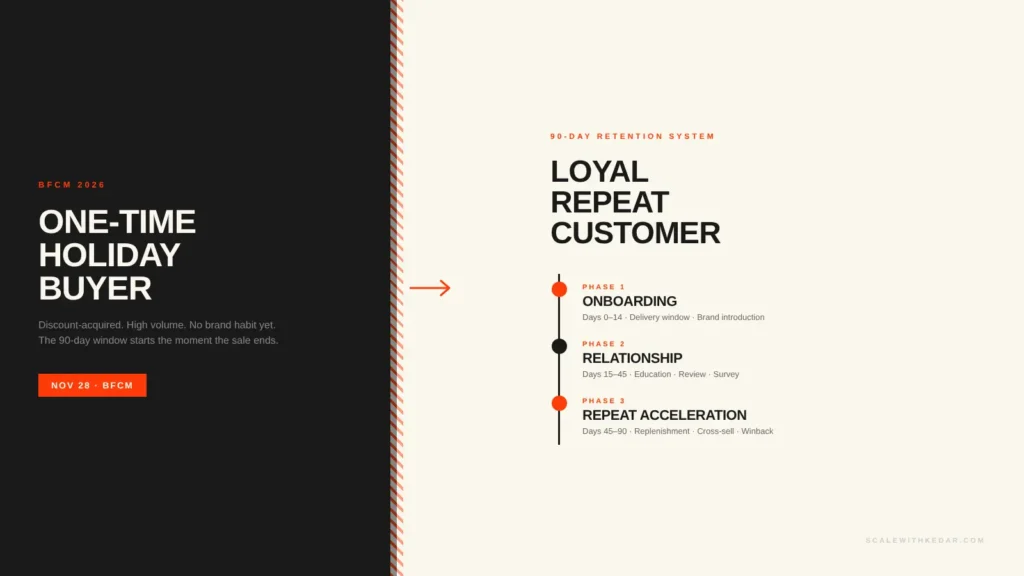
Invest in post-purchase automation: order confirmation, delivery update, review request, replenishment reminder at day 30/60, and a cross-sell sequence. These flows cost almost nothing to set up and run, and they compound in value the longer you keep them active.
6. Reduce COD Orders to Cut Return-Driven CAC
COD orders have significantly higher return rates — sometimes 30–40% compared to 8–12% for prepaid. Returns inflate your effective CAC because you’re spending to acquire customers who ultimately don’t generate revenue (and you incur reverse logistics costs on top).
Tactics that work: offer a small prepaid discount (even ₹30–50 can shift behaviour at checkout), use RTO intelligence tools to flag high-risk COD pincodes and orders proactively, and retarget COD customers within 24 hours of order placement with a “pay online and save” message over WhatsApp.
How to Track CAC Accurately When Attribution Is Broken
With iOS restrictions and Meta’s limitations, tracking CAC precisely is harder than it was three years ago. Here’s what actually works in 2026:
- Server-side tracking (Meta CAPI): Implement the Conversions API to send purchase events server-side in addition to the pixel. This typically recovers 15–25% of purchase events that get blocked by browsers or ad blockers.
- GA4 e-commerce tracking: Set up a properly configured GA4 instance with purchase events to get channel-level conversion data independent of Meta’s or Google’s reported numbers.
- MER (Marketing Efficiency Ratio): This is simply total revenue ÷ total ad spend, and it’s a much more stable metric than platform-reported ROAS. Track it weekly as your north-star efficiency metric.
- Contribution margin per order: Go beyond surface-level ROAS and track revenue minus COGS, shipping cost, payment gateway fees, return rate, and marketing cost. This is your real profitability number.
What Is a Good CAC for D2C Brands in India?
There’s no single correct benchmark — it depends on your category, AOV, and margin structure. But these are general reference ranges based on publicly available D2C data:
- Fashion / Apparel: ₹300–600 (highly competitive category, lower repeat rates)
- Beauty and Skincare: ₹400–800 (high LTV potential if products retain customers)
- Health and Nutrition: ₹500–1,000 (subscription models can justify higher acquisition spend)
- Home and Kitchen: ₹250–500 (lower purchase frequency, so CAC needs to stay tight)
What matters more than the absolute number is your CAC-to-LTV ratio and whether your CAC is trending downward quarter over quarter. A CAC of ₹1,000 can be perfectly sustainable with the right LTV — and a CAC of ₹300 can still destroy a business with poor retention.
The Bottom Line
Lowering CAC isn’t about cutting your ad budget — it’s about building a system where every rupee of marketing spend works harder. That means better conversion rates on your site, a referral loop that generates low-cost customers, smarter paid targeting, a strong retention engine, and reliable attribution to understand what’s actually moving the needle.
Pick one lever from this playbook, implement it this week, measure the impact over 30 days, then move to the next one. That’s how profitable D2C brands are built in India — one compounding improvement at a time.