Here’s a question every D2C founder in India asks at some point: “Why does it feel like we’re always chasing new customers?” If your growth plan depends entirely on acquiring fresh buyers every month, you’re leaving serious money on the table — and making your business unnecessarily fragile.
The brands that win in Indian D2C aren’t just the ones with the best ads. They’re the ones that get a customer to buy once, then twice, then become a loyal repeat buyer who also tells their friends. That’s the power of building a strong Customer Lifetime Value (CLV) strategy — and in this guide, we’ll break down exactly how to do it for your brand.
What Is Customer Lifetime Value (CLV) and Why Does It Matter for Indian D2C Brands?
Customer Lifetime Value is the total revenue a customer is expected to generate for your business over the entire duration of their relationship with you. In simple terms: how much money does one customer bring in, not just on their first order, but across every future purchase?
Here’s why this matters specifically for Indian D2C brands right now:
- Meta and Google ad costs are rising. Customer acquisition is getting more expensive every quarter. If your Customer Acquisition Cost (CAC) is high and your CLV is low, you’re burning money.
- Repeat buyers are far cheaper to convert. You’ve already built trust. No creative fatigue, no cold audience targeting — just a well-timed message to someone who already loves your product.
- It’s a sustainability metric. Investors and VCs look at CLV:CAC ratio closely. A ratio of 3:1 or higher signals a healthy, scalable D2C business.
How to Calculate CLV for Your D2C Brand
The basic formula is straightforward:
CLV = Average Order Value (AOV) × Purchase Frequency × Average Customer Lifespan
For example: if your AOV is ₹800, customers buy 3 times a year on average, and they stay with your brand for 2 years, your CLV is ₹4,800.
Now, the goal of your CLV strategy is to increase one or more of these three levers:
- Increase AOV (get customers to spend more per order)
- Increase purchase frequency (get them to buy more often)
- Extend customer lifespan (keep them engaged longer before they churn)
Step 1: Segment Your Customers by CLV
Not all customers are equal. The first and most important step is to segment your customer base using RFM analysis — Recency, Frequency, and Monetary value.
- Champions: Bought recently, buy often, high spend. Treat them like VIPs.
- Loyal Customers: Buy regularly. Focus on upsells and referral nudges.
- At-Risk Customers: Haven’t bought in a while but were once active. Winback campaigns are your priority here.
- New Customers: Only bought once. Your post-purchase flow is critical to convert them to repeat buyers.
- Lost Customers: Inactive for 6+ months. A discount or a “we miss you” campaign is worth trying, but don’t over-invest here.
Tools like Klaviyo, WebEngage, MoEngage, and even Shopify’s built-in analytics can help you build these segments automatically.
Step 2: Build a First Purchase to Second Purchase Flow
This is where most Indian D2C brands drop the ball. They obsess over the first sale and then go completely silent. The window after the first purchase is your single biggest opportunity to build a repeat buyer.
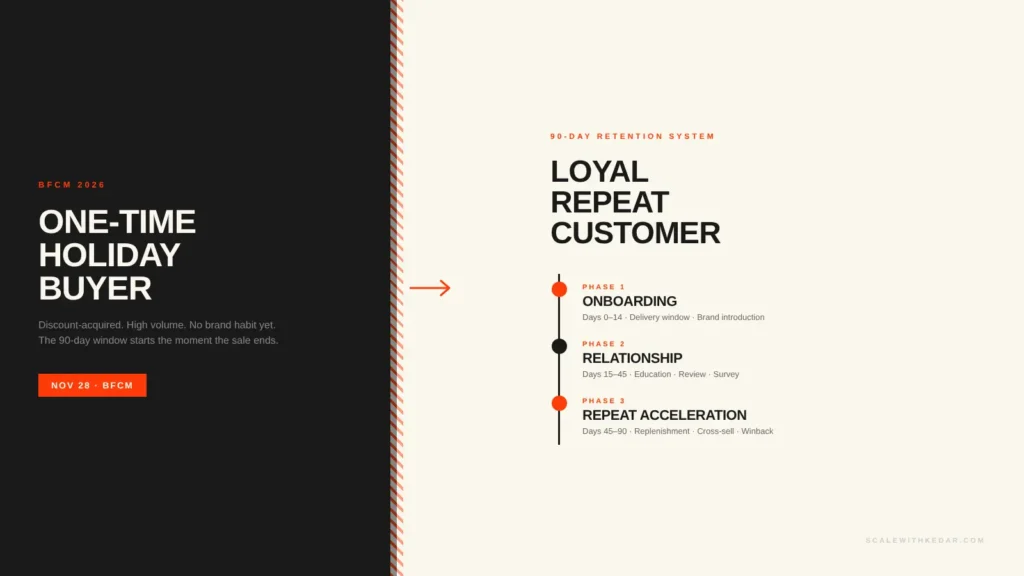
Here’s a practical post-purchase sequence that works:
- Day 0 (Order Confirmation): Thank you message on email and WhatsApp. Make it warm, personal, and brand-focused — not just transactional.
- Day 3-5 (Delivery): Trigger a message asking for feedback. Surface happy customers for reviews and catch dissatisfied ones before they churn.
- Day 10-14 (Re-engage): Send a “how are you enjoying [product]?” message with a cross-sell or complementary product recommendation.
- Day 21-30 (Repurchase Nudge): If it’s a consumable, send a “time to restock” reminder. If non-consumable, offer a complementary SKU at a bundled price.
WhatsApp Business API — via tools like Interakt, Wati, or Gupshup — is particularly effective for this in India, given the country’s WhatsApp penetration. Email alone won’t cut it for most Indian D2C audiences.
Step 3: Use Loyalty Programmes to Drive Purchase Frequency
Loyalty programmes in India don’t have to be complicated. The simplest models work best:
- Points-based: Earn points per rupee spent, redeem after a threshold. Works well for consumables and beauty brands.
- Tiered membership: Silver, Gold, Platinum tiers with escalating benefits. Creates status and aspiration, and gives customers a reason to consolidate their spending with you.
- Subscription/Prepaid models: Encourage customers to subscribe for a product bundle at a discount. Great for personal care, nutrition, and pet brands.
Tools like LoyaltyLion, Yotpo Loyalty, and several Indian-built solutions integrate well with Shopify-based stores. Choose one that fits your tech stack and start simple — you can add complexity later.
Step 4: Personalise Your Communication at Scale
Personalisation doesn’t just mean using someone’s first name in a subject line. It means sending the right message, to the right segment, at the right time.
Practical examples for Indian D2C brands:
- A customer who bought your face wash twice but never tried the moisturiser → recommend it with a bundling offer.
- A customer who only buys during sales → send early access to your next sale to make them feel special without permanently training them to wait for discounts.
- A Champion-tier customer → invite them to a WhatsApp VIP group or offer a referral bonus with higher-than-usual rewards.
Most Indian D2C brands are sitting on a goldmine of behavioural data — order history, browsing behaviour, category preferences — and not using any of it. Start with one personalised segment per week. That compounding effort makes a measurable difference over 6-12 months.
Step 5: Track the Right Metrics Every Month
You can’t improve what you don’t measure. These are the CLV KPIs to track monthly:
- Repeat Purchase Rate (RPR): What percentage of your customers have bought more than once? For most Indian D2C brands, consistently improving this number is the single most impactful CLV lever.
- Time to Second Purchase: How many days between first and second order on average? Reducing this directly improves your CLV trajectory.
- Customer Churn Rate: What percentage of customers stop buying after 90 or 180 days? Segment this by acquisition channel to find which sources bring you the most loyal buyers.
- CLV:CAC Ratio: Aim for 3:1 or higher for a sustainable D2C model. If your CLV is ₹2,000 and your CAC is ₹1,800, something is structurally wrong.
- Net Revenue Retention (NRR): For subscription-based brands, are existing customers spending more or less than last year? Above 100% NRR means growth even without new customers.
The CLV Mindset Shift Every Indian D2C Founder Needs
Building CLV is not a campaign — it’s a business philosophy. It means shifting your entire team’s orientation from “how do we hit this month’s revenue target” to “how do we build relationships that generate revenue for the next two years?”
The D2C brands that dominate Indian e-commerce in the next few years won’t just be the ones who spend the most on ads. They’ll be the ones who master keeping customers happy, engaged, and coming back — consistently, scalably, and profitably.
Start with one thing this week: map out your first-to-second purchase flow and plug the gaps. That single change, executed consistently, is one of the highest-ROI moves you can make for your D2C brand right now.