The Sale Is Just the Beginning
Every D2C founder in India obsesses over acquiring the first order. Ad spend, creative strategy, landing page CRO — it’s all pre-purchase. But here’s the uncomfortable truth: the moment a customer clicks “Place Order” is when your real work begins. If you don’t have a deliberate post-purchase flow, you’re leaving repeat revenue, reviews, and word-of-mouth on the table — every single day.
In a market like India where customer acquisition costs are rising and margins are thinning, your ability to extract maximum value from each buyer is no longer optional — it’s survival. This guide walks you through building a post-purchase flow that does three things: increases order value, collects social proof, and creates loyal repeat buyers.
What Is a Post-Purchase Flow (and Why Indian D2C Brands Ignore It)
A post-purchase flow is the structured series of touchpoints — emails, WhatsApp messages, SMS, and in-app nudges — that happen after a customer buys from you. Most Indian D2C brands send exactly one automated message: the order confirmation. That’s it.
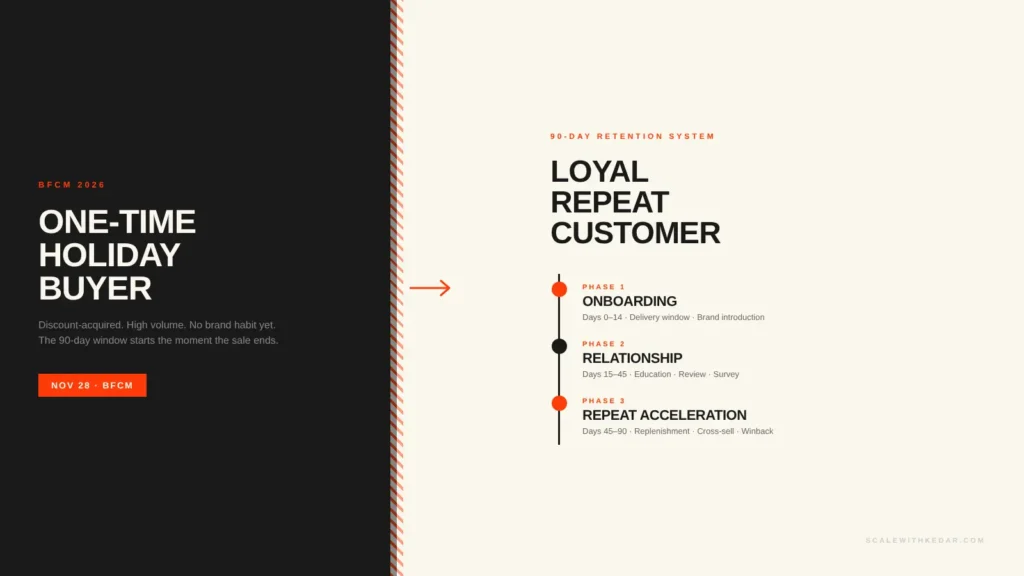
The brands that are winning in 2026 — whether in skincare, food, apparel, or home goods — treat post-purchase as a full funnel with clear goals at each stage:
- Stage 1 (Day 0–2): Reassurance and excitement
- Stage 2 (Day 3–7): Pre-delivery anticipation and upsell
- Stage 3 (Day 7–14): Review collection and community invite
- Stage 4 (Day 15–45): Replenishment nudge and loyalty activation
Stage 1 — The “You Made a Great Choice” Window (Day 0 to 2)
Buyer’s remorse is real, especially in India where COD orders still have high cancellation rates. Your first job is to reinforce the purchase decision before the product arrives.
Order Confirmation Email (Within 30 Minutes)
This should not be a plain transactional email. Include a brief story about why you started the brand, a small teaser of what they’ll experience when they open the package, and a clear tracking link. If you’re on Shopify + Klaviyo or WebEngage, this is a 15-minute setup.
WhatsApp Welcome Message (Within 2 Hours)
If the customer opted into WhatsApp (and in India, 90%+ will), send a warm, human-sounding message. Not “Your order #12345 is confirmed.” Instead: “Hey! Your [Product Name] is on its way. Here’s a quick tip to get the most out of it from Day 1: [TIP]. We’ll update you as it ships!”
The Upsell Moment
In the order confirmation email or the post-purchase page itself, offer a complementary product at a one-time discount (10–15%). This is the easiest upsell you’ll ever run — the customer’s wallet is already open. Tools like ReConvert (Shopify) or custom post-purchase pages on WooCommerce make this straightforward.
Stage 2 — Shipping Updates + Pre-Delivery Upsell (Day 3 to 7)
Indian customers, especially first-time buyers, check tracking obsessively. Use shipping milestones as marketing touchpoints, not just logistics notifications.
Shipped Email — Include a Cross-Sell
“Your order is on the way! 🎉 While you wait, 73% of customers who bought [Product A] also love [Product B]. Grab yours now at 10% off with code FIRSTORDER.” This cross-sell email consistently outperforms standard promotional campaigns because intent is highest right after purchase.
Out for Delivery WhatsApp + SMS
This message has the highest open rate of any message you’ll ever send. Use it wisely — include unboxing instructions, a link to your community (WhatsApp group, Instagram page, or Discord), and set expectations for the first-use experience.
Stage 3 — Review Collection + Social Proof (Day 7 to 14)
Reviews are the lifeblood of D2C in India. On marketplaces like Amazon and Flipkart, they drive conversion directly. On your own website, they reduce return rates and support your ad creative. Yet most brands ask for reviews poorly — a generic “How was your order?” WhatsApp blast that gets ignored.

The Right Way to Ask for a Review
- Personalise it: “Hey [Name], we hope you’re loving your [Product]. Mind telling us what you think?”
- Make it dead easy: One click to a Google form, a Trustpilot widget, or your Shopify review app. Never make them hunt for a review page.
- Incentivise ethically: Offer a discount on their next order in exchange for an honest review — not a 5-star review specifically. “Leave us a quick review and get ₹100 off your next order.”
- Time it right: Wait until Day 7 (after product delivery and at least a few days of use) before asking. Asking at Day 1 after delivery almost never works for experience-based products.
UGC Invite
Ask customers to share a photo or video on Instagram and tag your brand. The most effective way: include a printed card in the packaging itself with a QR code linking to an Instagram hashtag or a Google Photos upload link. This drives organic UGC without any paid effort.
Stage 4 — Replenishment, Loyalty and Win-Back (Day 15 to 45)
This is where most D2C brands in India are completely silent. And that silence is why CAC keeps going up — you’re re-acquiring customers you already won.
Replenishment Nudge
If you sell consumables (skincare, supplements, food, cleaning products), map your product’s average use cycle. A 30ml face serum lasts roughly 45 days. Schedule an email or WhatsApp at Day 30: “Running low on [Product]? Stock up before you run out — and get 5% off when you auto-subscribe.” Tools like Skio or Appstle (for Shopify) make subscription upsells easy.
Loyalty Programme Activation
You don’t need a complex points system. Even a simple tier system — “Silver (1 order), Gold (3 orders), Platinum (5+ orders)” with increasing perks — creates powerful repeat purchase behaviour. Announce it in a Day 15 email: “You’ve joined our Silver circle! Here’s what you unlocked.” Smile.io and LoyaltyLion integrate with Shopify; for WooCommerce, WPLoyalty works well.
Win-Back Flow (Day 45+)
If a customer hasn’t bought again by Day 45 for a replenishable product, trigger a win-back sequence: a “We miss you” email with a compelling offer (₹150 off, free gift, BOGO), followed by a WhatsApp nudge 3 days later if they don’t open the email. Keep it to 3 touches max — beyond that, you’re just burning your sender reputation.
Metrics That Actually Matter in Your Post-Purchase Flow
Once your flow is live, track these numbers weekly:
- Repeat Purchase Rate (RPR): What % of first-time buyers return within 90 days? Benchmark: 20–30% for Indian D2C.
- Review Conversion Rate: What % of buyers leave a review after the ask? Aim for 10–20%.
- Post-Purchase Email Open Rate: Should be 45–60%. If lower, personalise the subject line.
- Upsell Take Rate: The % of buyers who accept your post-purchase upsell. Aim for 5–15%.
- Customer Lifetime Value (CLV): The ultimate metric — are post-purchase flows increasing average CLV over 6 months?
Tools That Work Well for Indian D2C Brands
- Email: Klaviyo (best-in-class automation), Mailmodo (interactive emails), WebEngage (India-friendly)
- WhatsApp: Interakt, Wati, AiSensy — all have Shopify integrations and work within WhatsApp Business API
- Reviews: Okendo, Judge.me, Loox for Shopify; Google Reviews widget for standalone stores
- Loyalty: Smile.io, LoyaltyLion, WPLoyalty (WooCommerce)
- Subscriptions/Replenishment: Skio, Appstle, Bold Subscriptions
The Bottom Line
Building a post-purchase flow isn’t glamorous — it doesn’t have the buzz of a viral ad campaign or a killer Meta creative. But it consistently delivers the best ROI of any marketing activity you’ll run. When done right, it turns a one-time buyer into a brand advocate who repurchases, reviews, and refers — all without spending another rupee on acquisition.
Start with Stage 1 and 3 this week. Set up a proper order confirmation email and a Day-7 review ask. Measure for 30 days. Then layer in the upsells and loyalty mechanics. Your D2C brand will look very different 90 days from now.