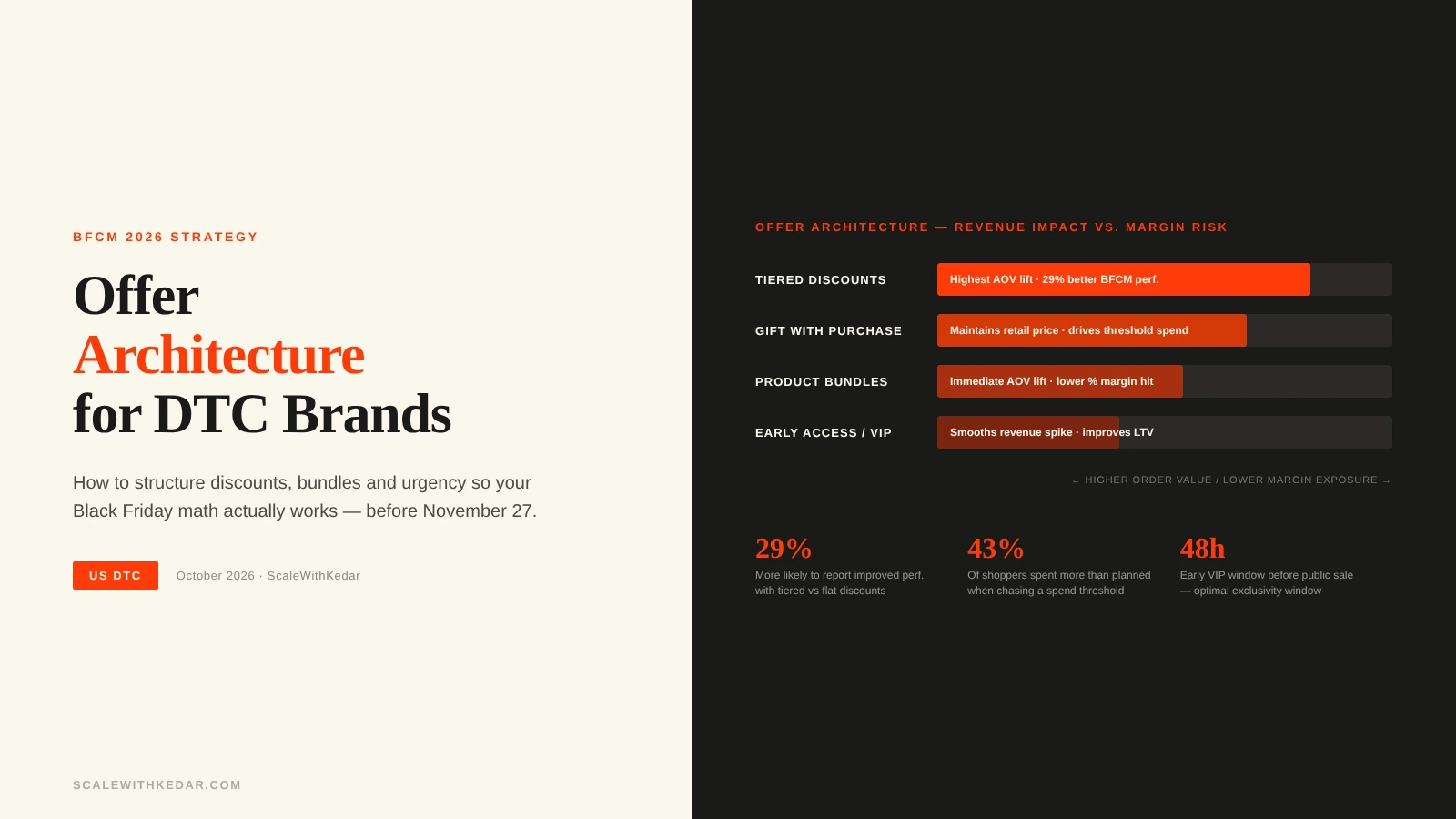
The most expensive BFCM mistake US DTC brands make isn’t running the wrong ad — it’s launching an offer that erodes margin without driving incremental revenue. A flat 30% off sitewide discount looks simple but often just pulls forward purchases from customers who would have bought anyway at full price. The brands that win Black Friday 2026 will architect their offers the way a fund manager builds a portfolio: the right instrument for the right objective, sized to the contribution math.
BFCM 2026 falls on Friday, November 27 (Black Friday) and Monday, November 30 (Cyber Monday). That gives you roughly six weeks from today to design, test, and build out your offer stack.
Why Flat Discounts Underperform — The Contribution Margin Problem
A 30% discount on a product with 55% gross margin leaves you at 25% gross margin before you touch paid media CAC, fulfillment, or returns. If your average order CAC is $18 and your AOV is $65, a 30% discount drops the margin contribution per order from roughly $17.75 to a loss before shipping. You can paper over this with volume, but most brands don’t generate enough incremental lift to compensate.
The profitable offer starts with the math, not the headline:
- Calculate your minimum viable AOV at target contribution: what’s the lowest order value at which you earn enough margin to cover your Q4 CAC and still hit contribution margin targets?
- Determine floor discount: what’s the maximum discount depth that keeps an average transaction above that minimum viable AOV?
- Design the offer to push customers above threshold, not just to trigger a purchase.
The Four Offer Types That Drive DTC BFCM Revenue
1. Tiered Discounts
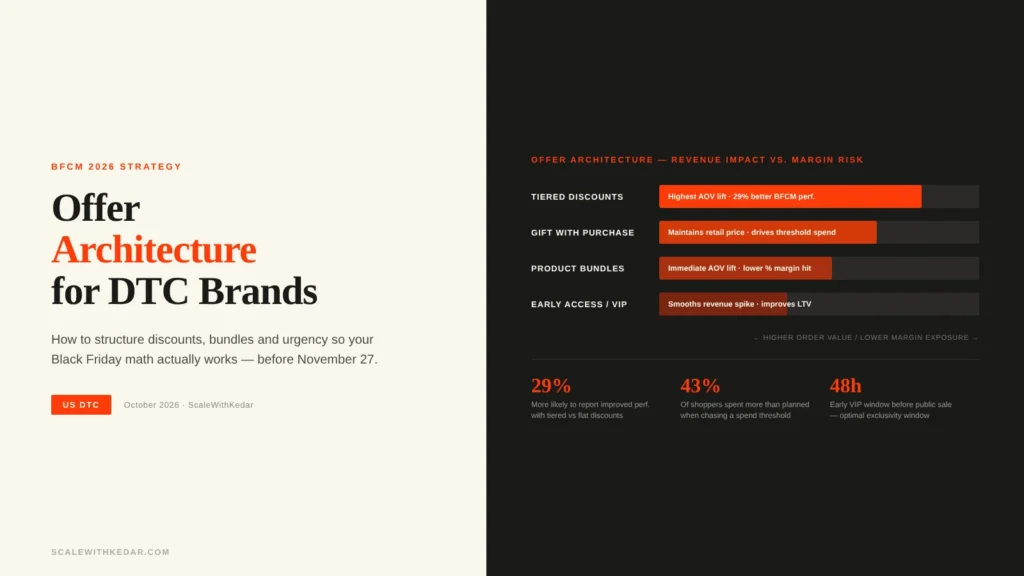
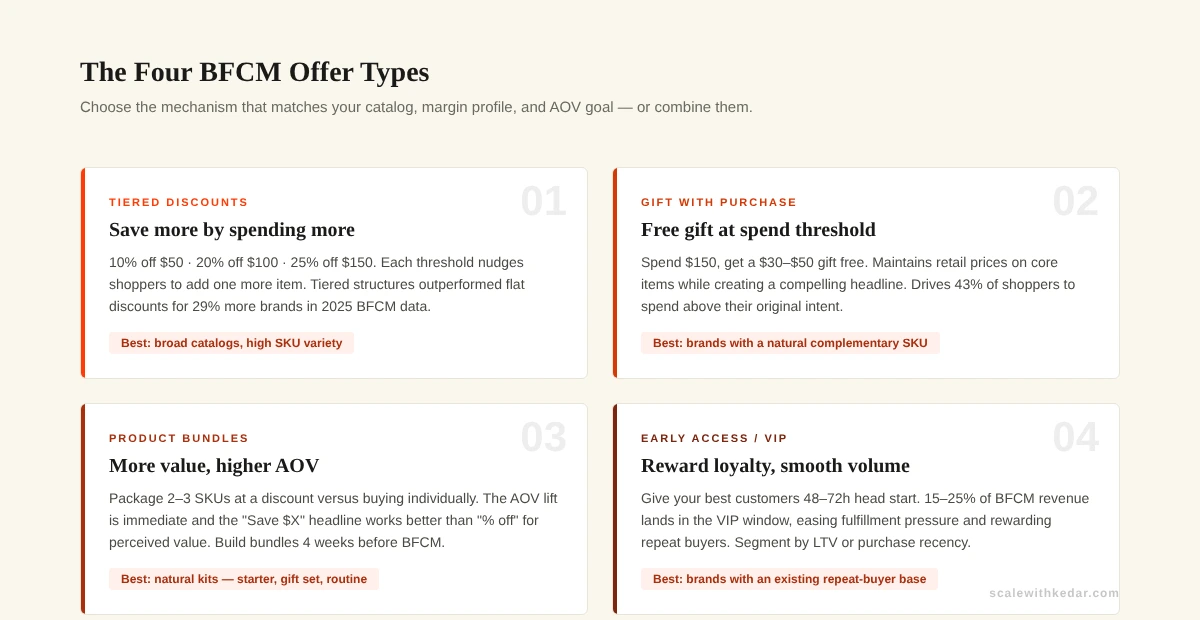
Tiered discounts scale incentives with order size: “Save 10% on orders over $50, 20% on orders over $100, 25% on orders over $150.” Research from email platforms analyzing the 2025 BFCM season found that marketers using tiered structures were 29% more likely to report improved performance compared to flat-discount counterparts. The key mechanism: a shopper planning a $90 order has a clear financial incentive to reach $100 rather than accept a smaller discount.
Best for: Brands with a broad catalog where a customer can realistically cross a spending threshold by adding one or two items.
Avoid if: Your catalog is narrow (one or two SKUs) — the threshold will feel manufactured.
2. Gift With Purchase (GWP) and Spend-Threshold Gifts
A GWP offer converts the incentive from a cash discount into a perceived value add. “Spend $150 and get [product worth $X] free” lets you maintain retail price on your core items while creating a compelling BFCM headline. The AOV lift is real: research on the 2025 season found that 43% of holiday shoppers spent more than they planned because they were chasing a better tier or free gift.
Best for: Brands with a hero product that can serve as the GWP (low incremental cost, high perceived value), or those with a clear complementary product that extends the main purchase.
Avoid if: Your margins are thin enough that adding a free product at 10–15% of order value is prohibitive. Do the math before committing.
3. Product Bundles
Bundles package two or more SKUs at a discount versus buying individually. The AOV lift is immediate, and the discount can appear larger (“Save $30”) without the same margin hit as a percentage discount across all items. Bundles work especially well if the combination solves a clear problem (“starter kit,” “morning routine,” “holiday gift set”) that the customer would logically want.
Build your BFCM bundles by late October so they’re in the system, tested in ads, and ready to feature on your email list. Launching a bundle on November 27 without prior testing is a waste of your highest-traffic day.
4. Early Access + VIP Tiers
Sending your best customers into BFCM 48–72 hours ahead of the public serves two business goals: it rewards loyalty (improving LTV), and it smooths your revenue spike rather than compressing all volume into 48 hours. Brands running early access to loyalty program members or high-LTV email subscribers typically see 15–25% of their BFCM revenue land before the public sale begins, easing fulfillment strain and improving customer experience.
Mechanism: Segment by purchase history (1+ purchases in the last 12 months), LTV tier, or VIP program membership. Email/SMS the early access window with a countdown. The offer itself can be identical to the public sale, but the exclusivity is the incentive.
Urgency Architecture: What Actually Works in 2026
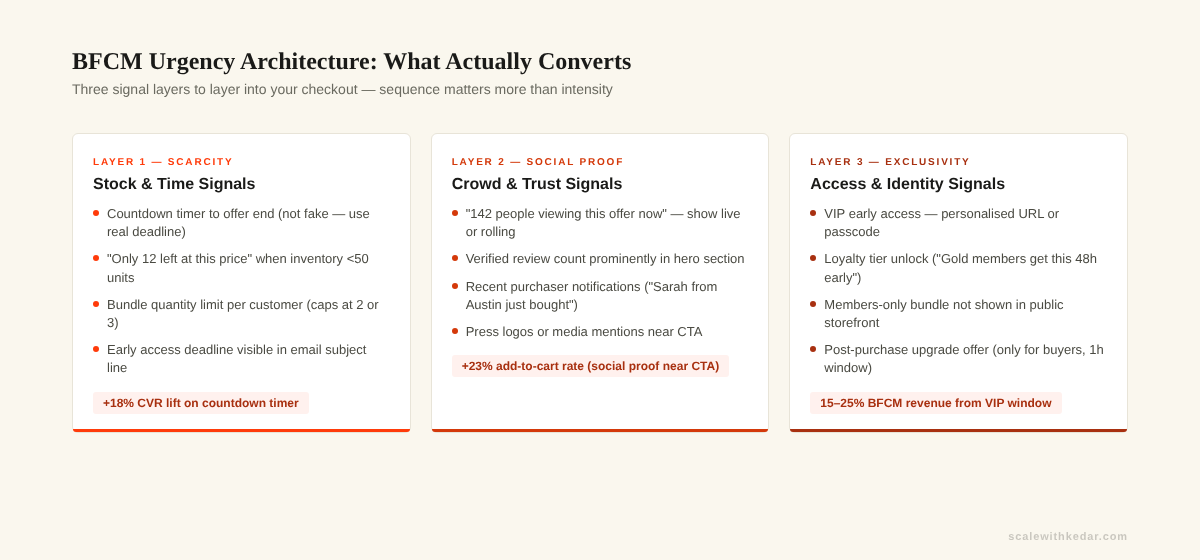
Urgency is the most abused tool in DTC BFCM playbooks. Fake countdown timers that reset, “only 3 left” claims on items with unlimited stock, and manufactured flash sales have eroded shopper trust. US consumers have become sophisticated; a visible reset timer or a “sale” that’s been running since October actively damages conversion.
Genuine Urgency Mechanisms
- Inventory scarcity: If you genuinely stock-constrain your BFCM allotment (e.g., only selling 500 units of a bundle at the offer price), communicate that honestly. “We’ve set aside 500 kits for this sale — when they’re gone, this price is gone” is credible and creates real urgency.
- Time-bounded flash sales: A 4–8 hour flash discount on a specific SKU creates genuine urgency without requiring fake timers. Email + SMS the flash window at the start; the brevity itself is the mechanism.
- Early-access closing countdown: “VIP access ends midnight Thursday” is a real deadline. Countdown timers on a genuine close date are appropriate urgency; countdown timers that reset are not.
- Shipping deadlines: For gift-intent purchases, “order by [date] for guaranteed Christmas delivery” is both urgent and useful. Carrier cutoff dates are firm and verifiable.
The BFCM Offer Calendar: Six-Week Timeline
| Week | Priority | Action |
|---|---|---|
| Weeks 1–2 (Oct 19–Nov 1) | Design and test | Finalize offer types and discount depths. Build bundle SKUs. A/B test landing page headlines and CTA copy. Segment your email list into VIP and standard tiers. |
| Weeks 3–4 (Nov 2–15) | Build and pre-qualify | Launch Klaviyo/Attentive BFCM segments. Begin SMS opt-in push. Set up tier-based discount codes in Shopify. Pre-qualify paid audiences for BFCM retargeting. |
| Week 5 (Nov 16–22) | Pre-warm | Send VIP early-access announcement email. “Something big is coming” teaser to full list. Load test your checkout if volume is expected to spike significantly. |
| Nov 23–26 (Pre-BFCM) | Early access | VIP and loyalty-tier email + SMS with exclusive access. Activate any GWP or bundle offers for this segment. Monitor checkout conversion rate daily. |
| Nov 27 (Black Friday) | Main event | Public sale launches. Email at 6 AM EST, SMS at 9 AM EST. Refresh mid-day with inventory update or flash sale if conversion is below forecast. Retargeting ads live. |
| Nov 28–29 | Cart recovery | Abandoned cart flow with BFCM-specific copy and deadline urgency. Winback email to lapsed buyers with BFCM context. |
| Nov 30 (Cyber Monday) | Final push | Cyber Monday offer (can mirror or slightly modify BF offer). Email at 8 AM EST + 6 PM EST “last chance.” SMS final-hour push at 9 PM EST. |
| Dec 1+ | Post-purchase activation | Welcome series for new buyers. Repeat-purchase email at Day 7, Day 14. LTV campaigns segmented by first-order AOV. |
Testing Your Offers Before November
Don’t wait until Black Friday to discover your offer doesn’t convert. Use the next four weeks to run controlled tests:
- Landing page A/B test: Send two versions of your BFCM landing page to a small email segment. Test the headline only (keep everything else identical). The winning headline goes into your main campaign.
- Offer depth test: Run a flash sale at two different discount depths to your list (split by segment). Measure revenue per recipient, not just conversion rate — a 25% discount that brings in more RPR than a 30% discount is a clear signal.
- Bundle viability: List your proposed BFCM bundle now. If customers find it before BFCM, note conversion rate. Sub-5% is a sign the bundle isn’t perceived as valuable enough to justify the price.
The BFCM Offer Audit Checklist
Before you finalize any BFCM offer, answer each question:
- Have you calculated the AOV floor that keeps this offer margin-positive after CAC?
- Does the offer incentivize customers to spend more, not just buy at all?
- Is every urgency mechanism real (inventory caps, genuine deadlines, accurate countdown timers)?
- Have you tested your checkout flow under offer conditions (discount code redemption, bundle pricing)?
- Is your VIP/early-access segment defined and sized? Do you know the expected revenue window?
- Have you assigned a post-purchase sequence to convert BFCM one-time buyers into repeat customers?
- Does your paid media budget reflect your offer calendar, with budget weighted toward the main event dates?
What to Do With BFCM Buyers After November
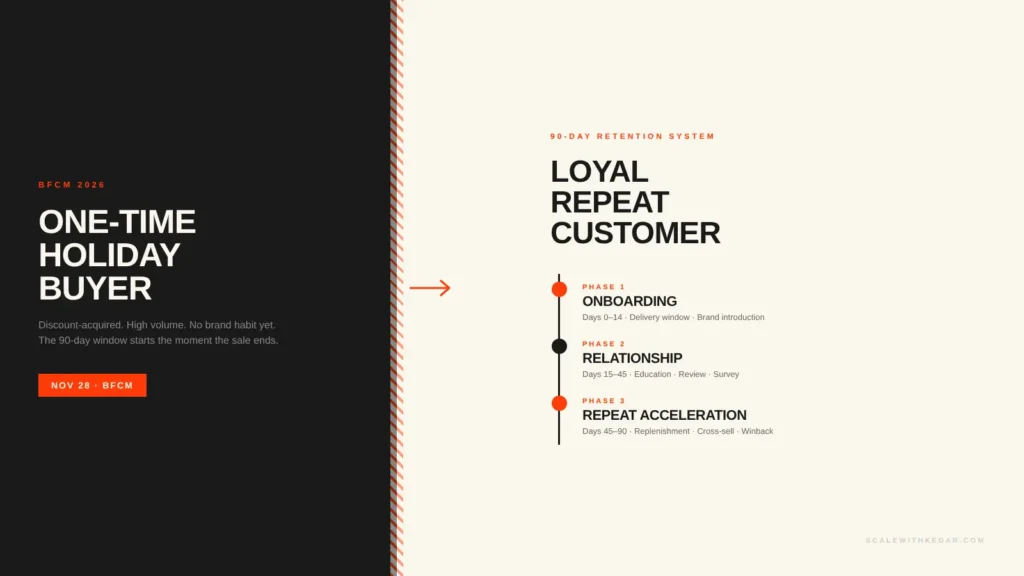
The most underutilized part of BFCM is what happens after Cyber Monday. New customers acquired at the highest volume of your year need a structured activation sequence, or you’ve paid the acquisition cost and gotten a single transaction with no repeat purchase. Build your Day 7, Day 14, and Day 30 post-purchase email triggers before BFCM, not after.
Segment BFCM acquirees from your regular buyer list — their first purchase was price-driven, which means their second purchase needs a value-focused reason to return. Educational content, loyalty program enrollment, and complementary product recommendations perform better than immediate discount re-engagement for this cohort.
Work With a DTC Growth Partner on Your BFCM Strategy
If you’re still finessing your offer architecture — or you need a second set of eyes on the margin math, paid media budget allocation, and email/SMS sequencing before November — that’s exactly what we audit for DTC brands at ScaleWithKedar.
We work with US ecommerce founders and marketing leaders on paid media, CRO, lifecycle marketing, and Q4 strategy. Tell us about your brand and your BFCM goals — we’ll respond within 24 hours with a recommended next step.
Frequently Asked Questions
What’s the best BFCM discount depth for a DTC brand?
There’s no universal number. Calculate your minimum viable AOV at target contribution margin first, then determine the maximum discount depth that keeps average transactions above that threshold. For most apparel and beauty brands, 20–25% on core SKUs paired with a spend threshold or GWP outperforms flat 30%+ discounts on margin.
Should I offer the same BFCM deal on Black Friday and Cyber Monday?
Most brands run identical or near-identical offers across both days. Shoppers expect it. What you can differentiate is the urgency mechanism: Black Friday gets the main launch, Cyber Monday gets the “last chance” messaging. Some brands introduce a new bundle or flash product specifically for Cyber Monday to maintain list engagement.
How early should I send early access to VIP customers?
48–72 hours before the public sale is the most common window. Longer than 72 hours risks buyer fatigue (they forget they have exclusive access); shorter than 48 hours doesn’t give enough time for the exclusivity to drive incremental revenue before the public launch.
Can I test BFCM offers without hurting my regular email list health?
Yes. Use a small holdout test with 5–10% of your list segments, test one variable at a time, and measure revenue per recipient rather than raw conversion rate. This gives you actionable signal without exposing your entire BFCM audience to an untested offer.