
Why Your Meta Ads ROAS Might Be Lying to You Right Now
If you’re running Meta Ads for a DTC brand in 2026 and your ROAS looks fine on paper but cash flow tells a different story, you’re not alone. The combination of iOS privacy changes, rising CPMs heading into Q4, and ever-more-competitive auction dynamics means that surface-level ROAS numbers can mask real profitability problems. The brands that dominate Q4 aren’t the ones spending more — they’re the ones who optimized smarter in August and September.
After researching and analyzing what’s working for US DTC brands right now, here are seven high-impact levers you should pull before the holiday rush begins.

1. Audit Your Attributed Window vs. Your Actual Purchase Cycle
Meta’s default attribution is a 7-day click, 1-day view window. For most DTC products under $100, this is reasonable. But if you’re selling a high-consideration product — a $300 mattress topper, a premium coffee subscription, a $250 kitchen appliance — your customer may browse on Tuesday and buy on Sunday. If you’re not checking the 28-day click window alongside your default, you’re under-attributing conversions and potentially cutting campaigns that are actually working.
The fix: In Ads Manager, compare the 7-day click window against 28-day click. If you see a meaningful gap (more than 20%), adjust your optimization patience accordingly. Don’t pause campaigns after 3 days — give them a full purchase cycle to show results.
2. Switch from Purchase-Optimized Campaigns to a Full-Funnel Stack
Meta’s algorithm has gotten extremely good at finding purchase-intent audiences — but only when you give it enough signal. If your pixel has fewer than 50 purchase events per week per ad set, the algorithm is running blind. Before Q4 hits and CPMs spike, build out a three-layer stack:
- Top of funnel: Optimize for Initiate Checkout or Add to Cart to widen the data pool
- Middle of funnel: Retarget video viewers (75%+) and page engagers with benefit-focused creative
- Bottom of funnel: Retarget cart abandoners and past purchasers with urgency-driven offers
This structure keeps the pixel fed with signals even when purchase volume is inconsistent, and it means your Q4 campaigns launch with a warm audience — not a cold one.
3. Fix Your Creative Before You Touch Your Budget
In 2026, creative is your primary targeting mechanism. With broad targeting and Advantage+ placements now dominant, the ad itself is doing the audience selection work. If your creative is generic, it will reach generic audiences at generic efficiency.
Before Q4, audit your top 10 ad creatives from the last 90 days and identify:
- Which hook (first 3 seconds) had the highest 3-second video view rate?
- Which ad format (static, carousel, Reel) drove the lowest cost per link click?
- Which product angle (pain point vs. aspiration vs. social proof) drove the highest landing page view-to-purchase rate?
Then produce 3-5 new creative variations based on your winners — not random new concepts. Iteration beats inspiration when budgets are on the line.
4. Consolidate Ad Sets to Escape the Learning Phase Trap
If you have more than 5-7 active ad sets per campaign, you’re probably keeping each of them in perpetual learning phase. Meta needs around 50 optimization events per ad set per week to exit learning — spread thin across 15 ad sets, you’ll never get there.
The Q4 play: merge your best-performing audiences into 3-4 consolidated ad sets, let each reach full learning, and only expand from a stable base. Less structure, better learning, better outcomes at scale.

5. Test Advantage+ Shopping Campaigns for Your Catalogue
Advantage+ Shopping Campaigns (ASC) have matured significantly. For DTC brands with a product catalogue, ASC can outperform manual campaigns by 15-30% on ROAS by letting Meta handle audience discovery, placement, and budget allocation simultaneously.
The key setup decisions that most brands get wrong:
- Set a meaningful existing customer budget cap (typically 20-30% of total ASC budget) so you’re not just cannibalising repeat purchases
- Upload your full creative variety — static, video, UGC — so Meta has options to optimise across formats
- Give it 2-3 full weeks before evaluating, not 5 days
6. Build Your Q4 Offer Architecture Now, Not in November
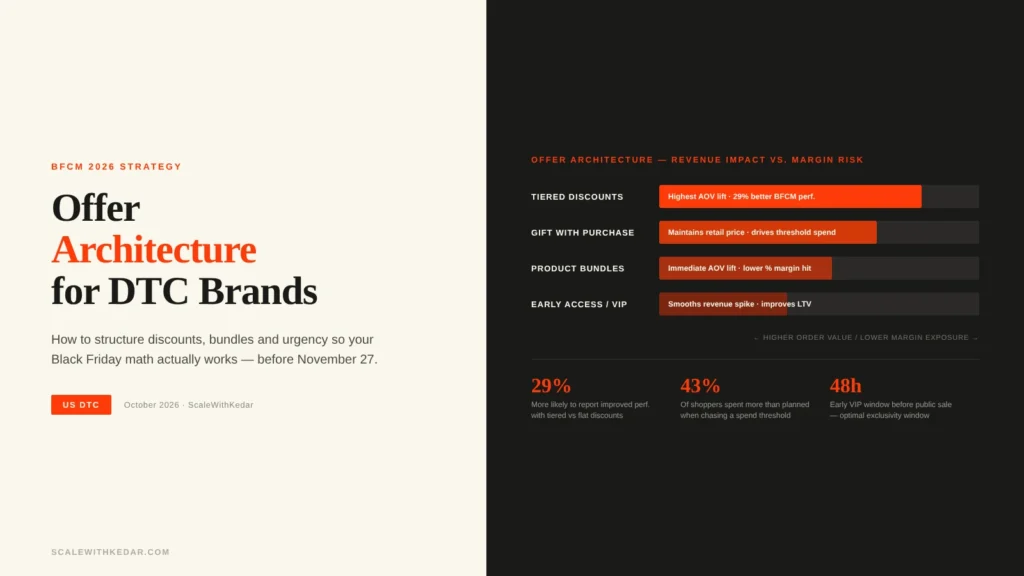
The biggest Meta Ads mistake DTC brands make heading into Q4 is treating it as a creative problem when it’s actually an offer problem. Black Friday/Cyber Monday auctions are brutal — CPMs can spike 3-4x. If your offer isn’t compelling enough to convert at those CPMs, no amount of creative testing will save you.
Use August and September to test offer angles at lower CPM levels:
- Bundle discounts vs. percentage off
- Free gift with purchase vs. free shipping
- Tiered incentives (spend $75 get X, spend $150 get Y)
Find what converts for your audience before the auction gets expensive. Then go into Q4 with a proven offer, not a hypothesis.
7. Set Up Incrementality Testing Before You Scale
Incrementality testing — running a Meta Conversion Lift study or a geo-based holdout test — tells you what percentage of your reported Meta conversions would have happened anyway through other channels. For many DTC brands, this number is 20-40%, meaning your true Meta ROAS is lower than you think.
Why does this matter before Q4? Because if you scale a campaign that’s over-attributing by 30%, you’ll spend into Q4 at elevated CPMs expecting returns that won’t materialise. A simple holdout test in September can calibrate your expectations and help you set realistic budgets for November.
The Bottom Line: Profitable Q4 Starts in Late August
The brands that have their most profitable Q4 in 2026 won’t be the ones who spent the most — they’ll be the ones who went into the holiday season with a battle-tested creative library, a consolidated campaign structure, a proven offer, and a realistic picture of what Meta is actually driving for their business.
These seven levers aren’t theoretical. They’re the same ones that separate DTC brands with sustainable paid media channels from the ones who chase ROAS in circles.
If you want help auditing your current Meta Ads structure before Q4, or building a performance marketing strategy from the ground up, reach out here — I work with US DTC founders who want profitable growth, not just traffic.
Frequently Asked Questions
What is a good ROAS for Meta Ads in 2026?
A “good” ROAS depends on your product margin. If your gross margin is 60%, a 2.5x ROAS might be profitable; if your margins are 30%, you may need 4x or more. Always calculate against your blended break-even ROAS before setting targets.
How do I improve Meta Ads performance before Q4?
Focus on creative quality, campaign consolidation, and full-funnel structure. Fix attribution windows, ensure your pixel has sufficient purchase signal, and test offers at lower CPMs before November.
Should I use Advantage+ or manual campaigns for Q4?
Both have a role. Advantage+ Shopping works well for catalogue-based brands with strong creative variety. Manual campaigns give you more control over audience segmentation for retargeting. Many brands run both in parallel and allocate budget based on performance.