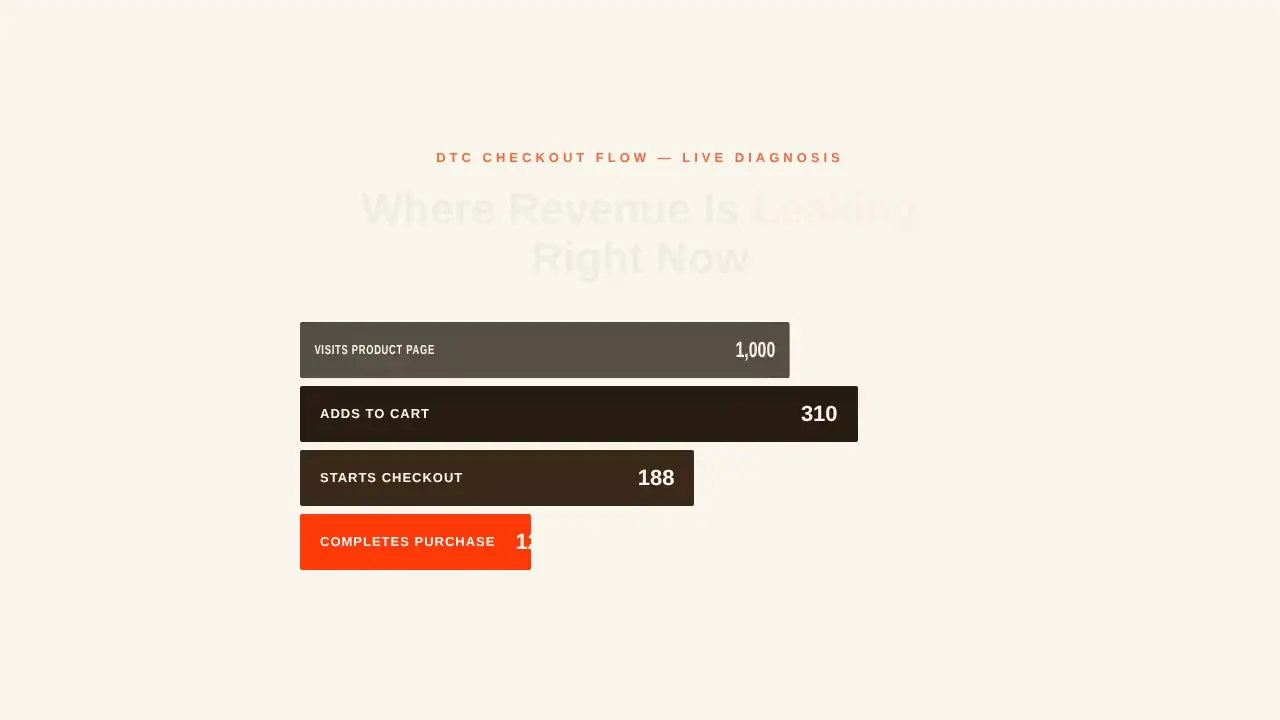
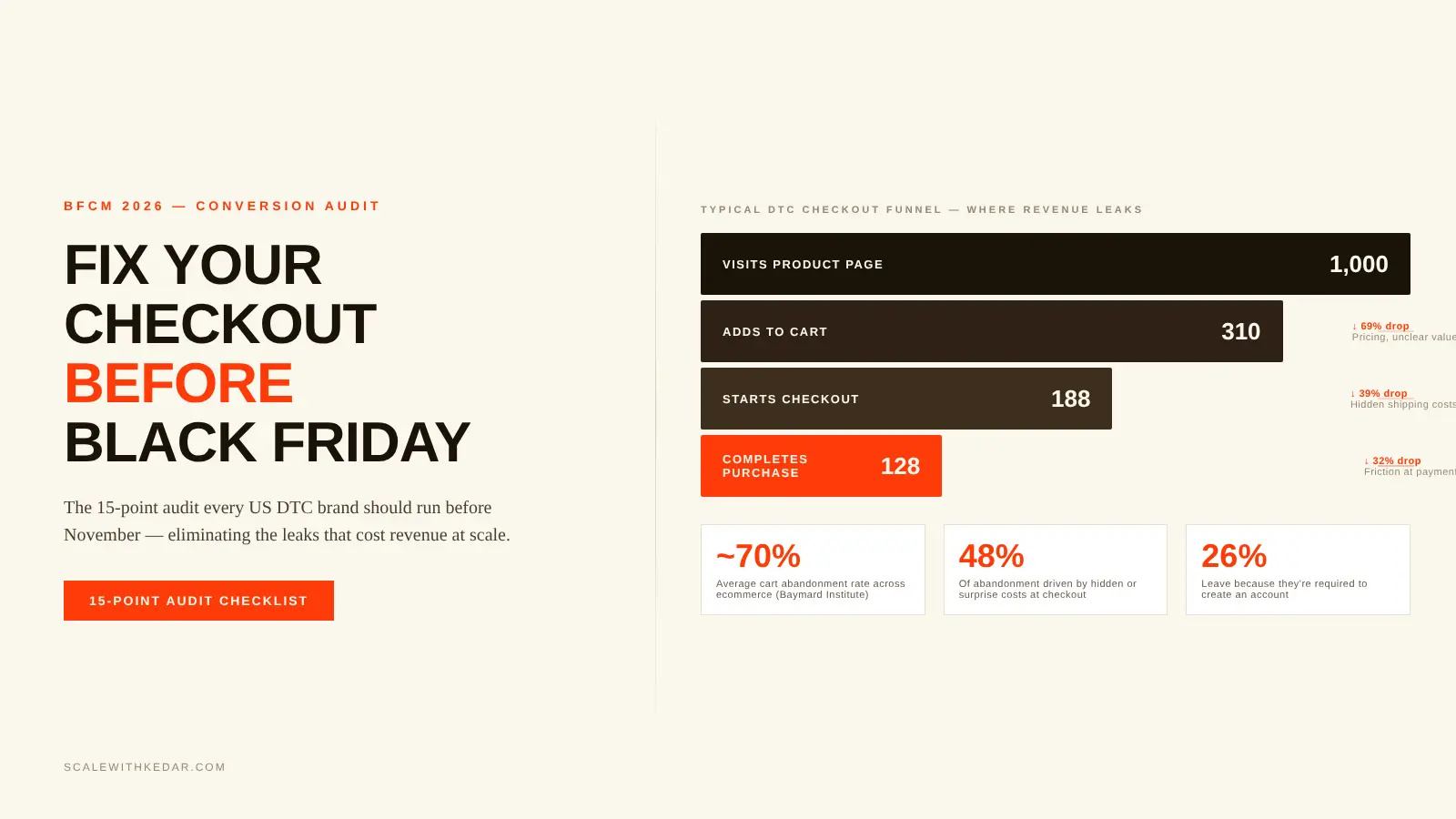
Your checkout flow is leaking revenue right now — and Black Friday will make every gap worse. The average ecommerce cart abandonment rate sits around 70%, according to Baymard Institute’s analysis of over 50 studies. For DTC brands heading into Q4 — especially after your BFCM paid media audit, that number translates to a very specific dollar figure sitting on the table every week.
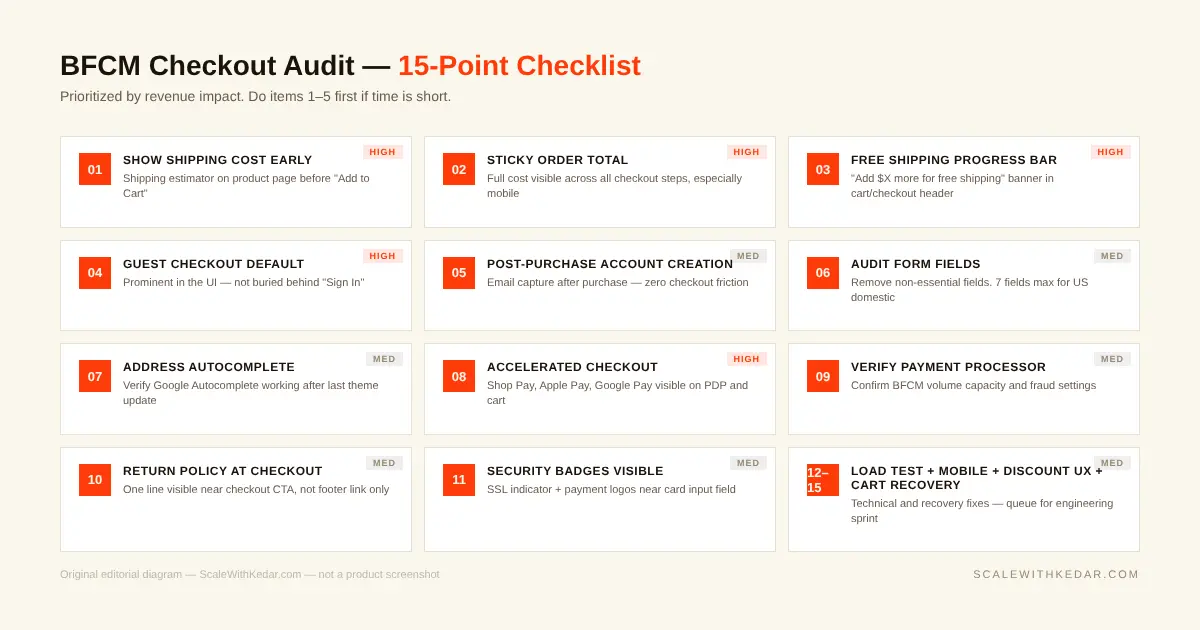
This 15-point audit gives you a concrete, prioritized checklist to diagnose and fix your biggest checkout leaks before BFCM 2026. Work through it in order: the top items drive the most recoverable revenue.
Why Checkout Problems Hit Harder During BFCM
Black Friday shoppers are already comparison-shopping. They open five tabs, add items to several carts, and the brand with the smoothest checkout wins. A friction point that costs you 5% of orders in September costs you 15–20% in late November when purchase intent is high but patience is thin.
Three things amplify checkout problems at scale:
- Traffic spikes expose slow load times. A server that handles 200 concurrent sessions fine may fail at 2,000.
- Promo code confusion multiplies abandonment. Every “apply code” flow that errors during a flash sale is a lost order.
- Return anxiety peaks. First-time buyers need clear return policies visible at checkout, not buried in the footer.
The 15-Point Checkout Audit
Part 1: Cost Transparency (Items 1–3)
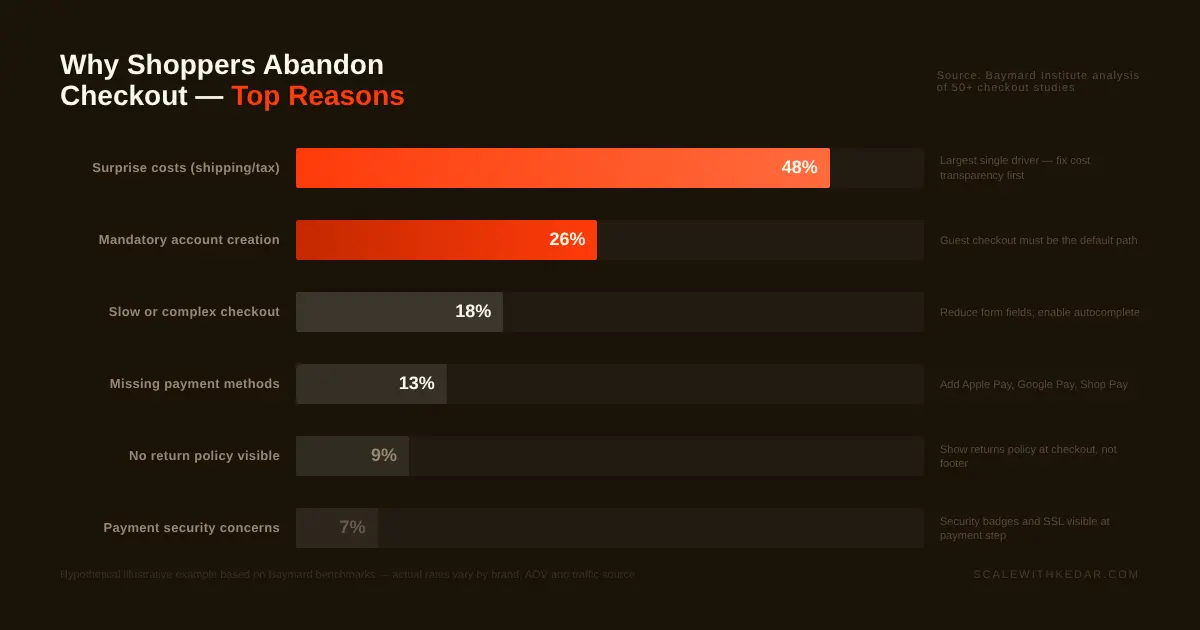
The single biggest driver of checkout abandonment is surprise costs at the final step. Baymard data shows 48% of abandonment is cost-related — high shipping fees, taxes, and other charges that only appear at checkout.
1. Show shipping cost on the product page
Add a shipping estimator or at minimum a “free shipping over $X” threshold callout on every product page. Shoppers who see the total cost before clicking “Add to Cart” convert at significantly higher rates than those who discover shipping at checkout.
How to audit: Add a test product to your cart on mobile. At what step does the total landed cost first appear? If it’s not until step 2+ of checkout, you have a leak.
2. Show the order total before the payment step
The order summary (product + shipping + taxes) should be visible and sticky on every checkout step, not just the last one. On mobile especially, shoppers often lose sight of their cart total as they scroll through the checkout form.
3. Display free shipping threshold progress
A simple “Add $12 more for free shipping” banner in the cart or checkout header is one of the highest-ROI conversion tactics in DTC. It addresses cost anxiety while simultaneously increasing average order value. This is one of the most underused mechanics before BFCM.
Part 2: Account Friction (Items 4–5)
Baymard data shows 26% of checkout abandonment comes from mandatory account creation. This is the second-largest single cause and it has a direct fix.
4. Confirm guest checkout is actually the default
Test your checkout right now with a fresh browser session. Does guest checkout appear as prominently as “sign in”? Many themes bury it. For BFCM, especially for buyers coming through paid social who are first-time visitors, guest checkout being the path of least resistance can meaningfully move your checkout rate.
5. Offer post-purchase account creation
Ask shoppers to create an account after they’ve already completed the purchase. You get the email capture, they get order tracking access — without the friction of stopping mid-checkout. Most Shopify themes support this natively; verify yours is configured correctly.
Part 3: Form Design and Fields (Items 6–7)
6. Audit your form field count
Every unnecessary field costs you conversion. For US domestic shipping, you typically need: email, name, address lines, city, state, ZIP, phone. That’s it. Remove “Company,” “Apartment/Suite” (move it to optional), and second address line when possible. On mobile, each extra tap is measurable abandonment.
7. Enable address autocomplete
Google’s Address Autocomplete API (or Shopify’s built-in address suggestions) reduces form time by 30–40% and eliminates typos that cause failed deliveries. Verify it’s enabled and working in your current theme — autocomplete breaks silently after theme updates.
Part 4: Payment Methods (Items 8–9)
Payment method friction accounts for roughly 13% of checkout abandonment, per Baymard benchmarks.
8. Enable accelerated checkout options
Shop Pay, Apple Pay, Google Pay, and PayPal Express allow repeat buyers to skip the checkout form entirely. For mobile buyers — who will represent 60–70%+ of your BFCM traffic — these one-tap options can be the difference between a purchase and an abandon. Check that each accelerated checkout button is displaying correctly on your product pages AND in cart.
9. Verify your payment processor is BFCM-ready
Contact your payment processor or review their status page. Some processors throttle authorization rates under high volume. Know your fallback option. If you’re on Shopify Payments, verify your fraud protection settings won’t over-flag legitimate high-volume orders during a flash sale.
Part 5: Trust and Anxiety Reduction (Items 10–11)
10. Place your return policy within the checkout view
A “30-day free returns” callout, even as a single line of text near the checkout button, consistently reduces abandonment for first-time buyers. Don’t rely on a footer link. Q4 buyers are particularly return-conscious — they’re often buying gifts for others.
11. Show security badges near the payment form
SSL indicator, accepted payment logos, and a short “Secure Checkout” label near the card field address the payment anxiety that causes last-second abandonment. These are table stakes, but verify they’re actually rendering — they break after theme updates too.
Part 6: Technical Performance (Items 12–13)
12. Load-test your checkout flow
Use a tool like k6 or Artillery to simulate 10x your average checkout traffic. The goal is to know where your infrastructure degrades before Black Friday, not during it. Key metrics to check: checkout page load time under load, payment step response time, and error rates at >500 concurrent users.
13. Fix checkout errors on mobile
Run your entire checkout flow on an iPhone (Safari) and an Android device (Chrome). Common mobile-specific issues: address autocomplete not triggering the correct keyboard type, expiry date fields not accepting two-digit month entry, and payment buttons cut off by the browser navigation bar. Each of these causes real abandonment that desktop testing won’t catch.
Part 7: Promo Code and Recovery (Items 14–15)
14. Audit your discount code UX
Test every promo code you plan to run for BFCM right now. Check: does the code apply correctly on both desktop and mobile? Is the “apply” button visible without scrolling? If the code is percentage-off, does the updated total display immediately? A broken discount code during a flash sale is a high-visibility failure that spreads on social.
15. Set up or verify your abandoned checkout email sequence (see also our Q4 email deliverability audit)
Shopify sends one abandoned checkout email by default, 10 hours after abandonment. That’s too slow for BFCM. Set your first email to fire within 30–60 minutes of abandonment. Add a second email at 24 hours with social proof or a small incentive if you have margin to support it. Verify these emails render correctly on mobile and that the “complete your purchase” link works.
How to Prioritize This Audit
If you have two weeks before your BFCM prep locks in, work in this order:
- Fix cost transparency (Items 1–3) — highest abandonment driver
- Enable all accelerated checkout options (Item 8)
- Verify abandoned cart sequence timing (Item 15)
- Fix mobile checkout issues (Item 13)
- Confirm guest checkout prominence (Item 4)
Items 5–7 and 9–12 are meaningful but require more dev time. Queue them for your engineering sprint, or note them as improvements for 2027 Q4 planning.
What to Measure After You Fix It
Track checkout initiation rate (cart → checkout step 1), checkout completion rate (checkout → order), and cart abandonment rate separately. Mixing them is a common reporting error that masks where your actual leak is.
Baseline each metric for the 14 days before any changes. Measure again for the 14 days after. With BFCM volume, you’ll have statistical significance faster than you would in a typical month.
A Note on Recovery Tactics
Abandoned checkout emails, retargeting ads, and SMS recovery sequences are important — but they’re a second chance at a lost sale, not a substitute for a well-optimized checkout. Every percentage point improvement in checkout completion rate is worth significantly more than an equivalent improvement in recovery rate, because it affects your primary conversion event, not a fallback.
Fix the checkout first. Layer recovery on top.
Get a Full Audit Before BFCM
The checklist above covers the most universal DTC checkout issues. But your specific funnel may have leaks that only show up in your data — a payment processor with a regional failure rate, a promo UX issue tied to your specific theme, or a checkout speed problem on certain mobile carriers.
If you’re a US DTC brand doing $1M+ in annual revenue and want a hands-on checkout and conversion audit before Black Friday, reach out for a strategy conversation. We work through your actual analytics, session recordings, and live checkout — not a generic checklist.
Frequently Asked Questions
What is a good checkout abandonment rate for DTC brands?
A pooled benchmark from an 8-store DTC panel puts checkout abandonment at roughly 32% (meaning 68% of shoppers who start checkout complete it). Cart abandonment — which includes shoppers who add to cart but never start checkout — averages closer to 70% across all ecommerce. The distinction matters for diagnosis: fixing checkout issues is different work from fixing add-to-cart dropoff.
How early should I complete my BFCM checkout audit?
Aim to complete all technical fixes by November 1 at the latest. The two weeks before BFCM are too late to surface and fix a payment processor issue or a broken mobile checkout flow. The earlier you run this audit, the more time you have for QA and the less risk you carry into your highest-revenue days.
Does Shopify handle checkout optimization automatically?
Shopify Checkout (the hosted checkout for Shopify and Shopify Plus) handles some baseline optimization — it includes Shop Pay, guest checkout, and address autocomplete. But many of the items on this checklist require active configuration, theme-level changes, or third-party app setup. Shopify doesn’t configure your abandoned cart email timing, your shipping cost transparency, or your return policy placement for you.