The BFCM sale ends. Most DTC brands celebrate the revenue spike and move on. The strategic ones immediately shift into retention mode — because the customers they just acquired are the most expensive to replace, and the 90 days that follow the sale will determine whether those buyers ever purchase again.
Here is the short answer: a structured post-purchase retention system, built before Black Friday, turns one-time discount buyers into full-price repeat customers. This guide covers the exact framework — phases, automations, segmentation, and measurement — that separates brands building LTV from brands chasing their next acquisition.
Why BFCM Buyers Behave Differently
Customers acquired during a sale are not the same as customers who discovered your brand organically. The discount was the primary purchase driver. That does not make them bad customers — it makes them uninitiated ones. They bought at an exceptional price point they may not see again. They have no established habit around your product. They chose you partly because you were cheap, not necessarily because you were right for them.
This creates a specific problem: a post-purchase flow designed for organic buyers — which assumes some pre-existing brand affinity — will underperform on a BFCM cohort. The onboarding language, the timing, the education sequence, and the re-engagement approach all need to account for the discount-acquisition context.
The upside is that BFCM buyers represent a disproportionate share of total annual new customers for most DTC brands. Getting the retention economics right on this cohort can materially shift your annual LTV metrics.
The Post-Purchase Retention Clock
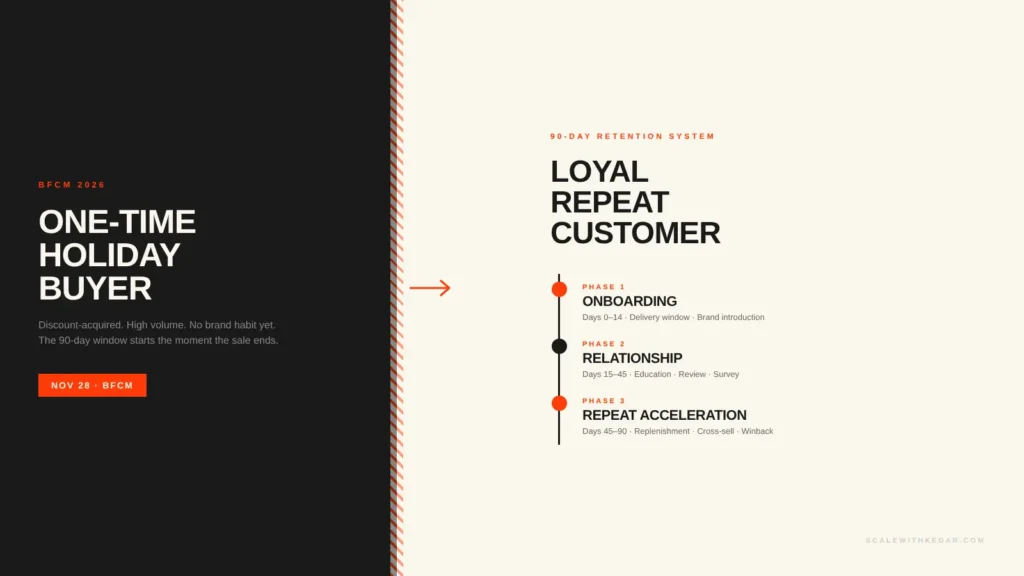
Think of the post-BFCM retention window in three phases. Each phase has a different objective and a different set of automations.
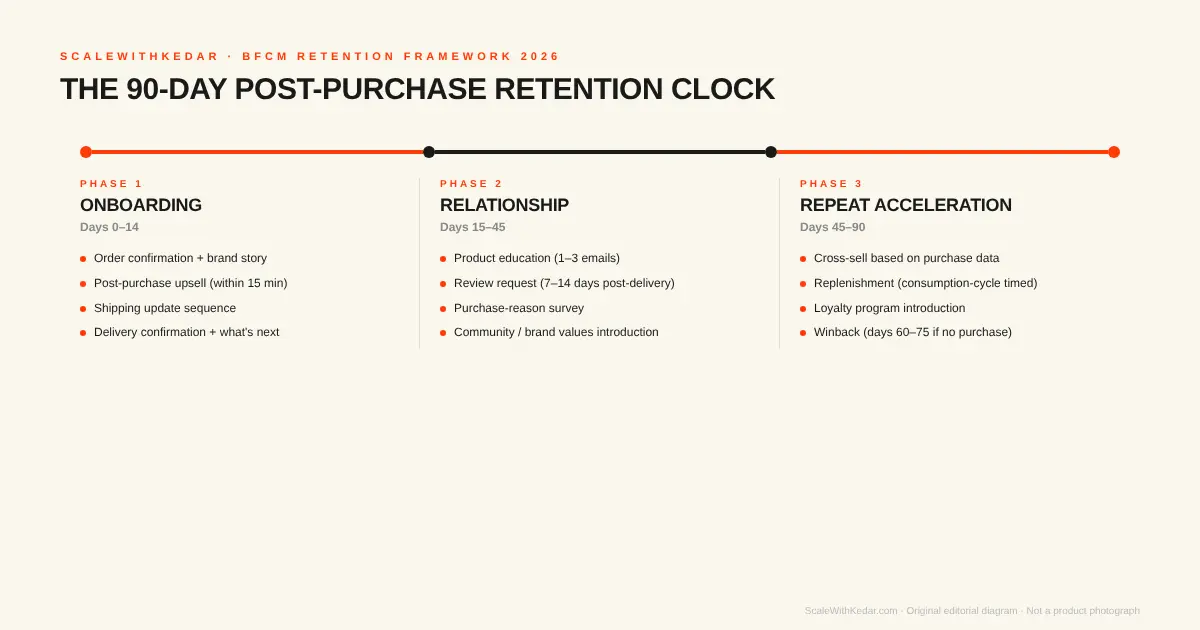
Phase 1: Onboarding (Days 0–14)
The window immediately after purchase — while the order is in transit and just after delivery — is the highest-engagement window you will have. Open rates are elevated. The buyer is curious, paying attention, and in a positive emotional state (they just bought something). Use this window to:
- Deliver transactional confidence (order confirmation, shipping updates)
- Introduce your brand story and product usage context
- Surface a one-click complementary product offer within the first 15 minutes of purchase while the buyer is still in a purchasing mindset
- Set expectations for what comes next
Phase 2: Relationship Building (Days 15–45)
By day 15, the product has been delivered and the novelty has settled. This is where most brands lose the plot — they either stop communicating or send generic promotional blasts. The retention-focused approach is different:
- Send a product education sequence (how to get the most from what they bought)
- Request a review at the right moment — 7–14 days post-delivery for most products, 21–30 days for consumables where the buyer needs time to actually use the product
- Survey the buyer about their purchase reasons — this data feeds your creative and segmentation for future campaigns
- Introduce community, content, or brand values that give the buyer a reason to stay engaged beyond the transaction
Phase 3: Repeat-Purchase Acceleration (Days 45–90)
The goal of Phase 3 is the second purchase — at full price. Industry analysis consistently shows that the likelihood of a customer buying again increases substantially after their second transaction. The biggest drop-off is between the first and second purchase. Phase 3 is designed to close that gap:
- Replenishment flows timed to your product’s consumption cycle
- Cross-sell sequences based on what the buyer purchased in Phase 1
- Loyalty program introduction (see our guide to DTC loyalty program strategy)
- Winback automation for buyers who have gone quiet before the 90-day window closes
The 7 Essential Post-Purchase Automations
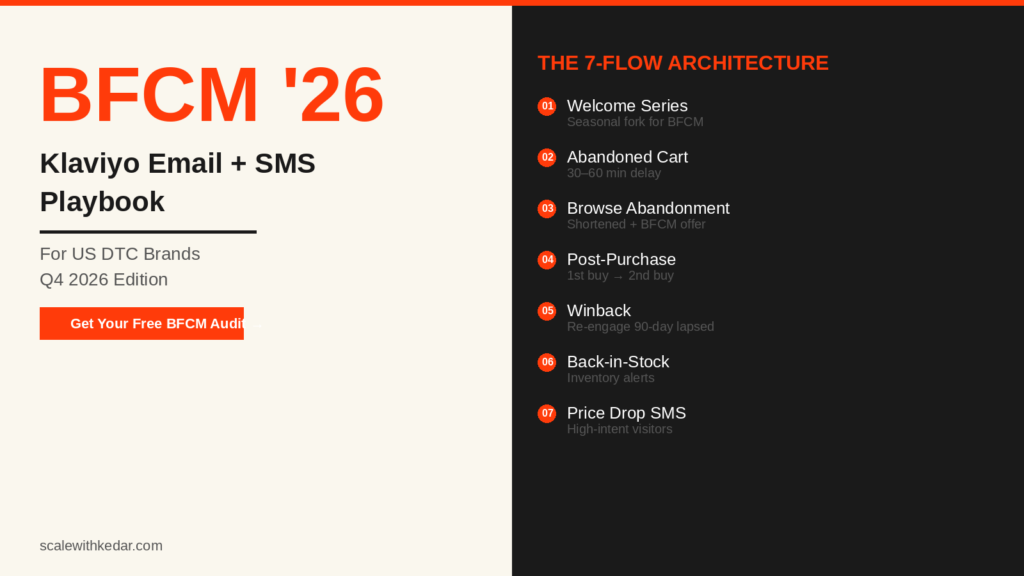
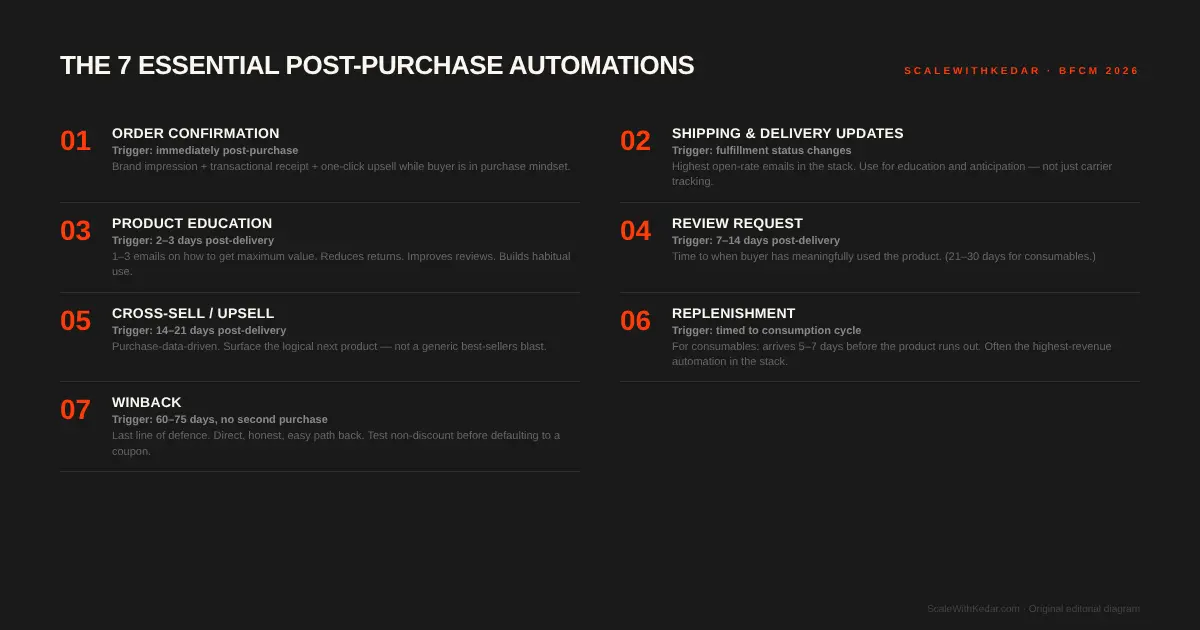
A complete post-BFCM retention system has seven automation sequences. Each serves a distinct job. Most brands have two or three of these in place. The gap between brands with strong retention economics and those without is usually found in the missing four or five.
- Order Confirmation — Trigger: immediately post-purchase. Beyond the transactional receipt, this is your first brand impression. Include a brief brand story element, what to expect next, and — if your platform supports it — a one-click post-purchase upsell.
- Shipping and Delivery Updates — Trigger: status changes from fulfillment. These emails have among the highest open rates of any message you will ever send. Most brands waste this by sending bare carrier tracking. Use it for education, social proof, and anticipation-building.
- Product Education Sequence — Trigger: 2–3 days post-delivery. 1–3 emails showing the buyer how to get maximum value from the product. This reduces returns, improves reviews, and builds habitual use. Customise by product category.
- Review Request — Trigger: 7–14 days post-delivery (or 21–30 days for consumables). Time this to when the buyer has meaningfully used the product. A well-timed review request converts far better than the default 3-days-post-shipping send that most apps default to.
- Cross-Sell / Upsell Sequence — Trigger: 14–21 days post-delivery. Based on what the buyer purchased, surface the logical next product. Use purchase data to make this specific, not generic.
- Replenishment Flow — Trigger: timed to product consumption cycle. For consumable or perishable products, this is often the highest-revenue automation in the entire stack. Time it to arrive in the buyer’s inbox 5–7 days before the product runs out.
- Winback — Trigger: 60–75 days post-purchase with no second transaction. This is the last line of defence before a buyer becomes a lapsed customer. Keep it direct — acknowledge the time gap, offer a reason to return, and make the path back easy.
For the email and SMS mechanics behind these flows, see our BFCM email and SMS flow strategy guide.
Segmentation: Not All BFCM Buyers Are Equal
Running every BFCM buyer through the same post-purchase flow is a common mistake. It creates two categories of errors: over-communicating with buyers who already have strong brand affinity, and under-investing in high-intent first-time buyers who signaled real engagement during the purchase.
First-Time vs. Repeat Buyers
Your post-BFCM flow should branch immediately based on purchase history. A first-time buyer needs full onboarding — brand introduction, education, social proof. A returning customer already knows your brand. Sending them the same onboarding sequence a new buyer gets is a measurable trust signal failure.
The most common finding in post-purchase flow audits: no exit conditions. A returning buyer re-entering the purchase flow gets the same Day 1 brand introduction they saw six months ago. Fix exit conditions before BFCM, not after.
High-Intent Buyer Signals
Some BFCM buyers send strong intent signals during the purchase itself. These buyers warrant a separate, elevated flow:
- Accepted a post-purchase upsell offer
- Purchased a bundle (versus a single item)
- Purchased multiple units
- Came from a loyalty program referral
These buyers are candidates for early VIP program introduction, higher-value cross-sell sequences, and loyalty milestone accelerators. Segment them out of the standard flow and treat them accordingly.
SMS as a Channel Parallel to Email
Email open rates during the period immediately following BFCM are historically lower than the rest of the year — holiday send volume from every brand the buyer is subscribed to competes for inbox attention. SMS is not subject to the same inbox noise. For key retention touchpoints — delivery confirmation, review request, winback — build SMS variants alongside your email sequences and let engagement data determine which channel lands. For the email deliverability foundations that make this work, see our Q4 email deliverability audit guide.
The Most Common Post-Purchase Audit Failures
Having reviewed post-purchase flows across DTC brands, the same failures appear repeatedly:
- No exit conditions. A customer who purchases again mid-flow keeps receiving onboarding messages that are now irrelevant. Every flow should check purchase history at each step and exit buyers who have already converted.
- Over-emailing in the first 7 days. The temptation to capitalise on post-purchase engagement leads some brands to stack 4–5 emails in the first week. This burns deliverability and trains buyers to ignore you. 2–3 touchpoints in the first 7 days is the upper bound for most products.
- Missing the SMS layer. Email-only post-purchase flows leave a meaningful channel unused. The highest-value BFCM buyers are often the ones most willing to opt into SMS during purchase.
- Generic product education. A single “tips for your new product” email that is not customised by SKU or product category performs poorly. Education content should match what the buyer actually purchased.
- Wrong review timing. Sending a review request 3 days after shipping — before many buyers have even received the product — is a default setting problem, not a strategy. Audit your platform defaults and override them.
- No winback boundary. Define a lapse threshold (typically 90–120 days post-purchase for most DTC categories) and stop sending after it. Continuing to email lapsed, unengaged subscribers damages deliverability.
Measurement: What to Actually Track
Post-purchase retention success is not measured in email open rates. It is measured in purchase behaviour. Track these metrics at the BFCM cohort level, not just for your overall customer base:
- Time to Second Purchase (T2SP). How many days between the BFCM purchase and the next transaction? This is your primary leading indicator of retention quality. Compare your BFCM cohort T2SP to your organic-acquisition T2SP — the gap tells you how much the discount-acquisition context is costing you in retention.
- Repeat Purchase Rate (RPR) at 90 Days. What percentage of BFCM buyers made a second purchase within 90 days of the first? Segment this by acquisition channel, product category, and first-purchase AOV.
- LTV Cohort Comparison. At 6 months and 12 months post-BFCM, compare the LTV of your BFCM cohort to your non-BFCM new customers from the same period. This tells you whether your retention system is closing the LTV gap between discount and organic acquisition.
- Flow Revenue Per Recipient. For each automation in your stack, track revenue per recipient and compare it to your one-off campaigns. Well-designed post-purchase flows should outperform campaign sends on this metric.
Treat small samples as inconclusive. BFCM cohort data takes 90–120 days to mature enough for meaningful conclusions. Do not optimise based on 2-week snapshots.
Frequently Asked Questions
How soon after BFCM should I build these flows?
Now — before BFCM. Post-purchase retention systems built in the week after Black Friday lose the highest-value window: the first 14 days after purchase. Build the flows in October so they are live and tested before the first BFCM order ships.
Should I offer a discount in my post-purchase winback email?
Not as a default. Discount-acquired BFCM buyers who receive another discount in their winback email are being trained that your brand’s actual price is negotiable. Test a non-discount winback (product education, social proof, urgency without a price cut) before defaulting to a coupon. If a discount is necessary to re-engage, tier it — offer less than the BFCM discount.
What platform should I use to build these flows?
The platform matters less than the segmentation logic and exit conditions. Klaviyo is the most common choice for DTC brands at scale because of its Shopify data integration and conditional splits. The flows described in this guide can be built in any ESP that supports conditional branching and purchase-event triggers. What cannot be replicated without proper data integration is accurate product-cycle replenishment timing and first-vs-repeat buyer segmentation.
How many emails is too many in a post-BFCM flow?
The directional benchmark from retention practitioners is 5–8 emails over 30–45 days. Fewer than 5 and you are leaving retention leverage unused. More than 8 and you risk deliverability and list fatigue. The more important variable is timing and content match — an 8-email flow that is perfectly timed and educationally relevant will outperform a 4-email flow of generic promotions.
Build Your BFCM Retention System Before the Sale
If you are heading into BFCM 2026 without a structured post-purchase retention stack — or if your current flows have the audit failures listed above — there is still time to fix it. We work with US DTC and ecommerce brands to design and implement post-purchase systems that turn holiday buyers into full-price repeat customers.
Book a strategy call and we will audit your current post-purchase flow and identify the highest-leverage gaps before November.