Rising customer acquisition cost (CAC) is the most consistent complaint from DTC founders in 2026. iOS privacy changes, rising CPMs, and copy-paste creative strategies have made it structurally harder to acquire customers profitably than it was two years ago. The brands that are navigating this successfully aren’t spending less — they’re spending smarter, on a specific set of levers that actually move the needle on CAC.
This is a practitioner’s breakdown of the framework I use to diagnose and reduce CAC for DTC skincare brands: from attribution accuracy through creative structure to retention economics. The principles generalise across DTC categories, but skincare has specific dynamics (long decision cycles, ingredient education, strong LTV potential) that make it a useful lens.
Editorial note: CAC reduction outcomes depend on product-market fit, existing account maturity, creative quality, and market conditions. The framework described here is a diagnostic and structural approach based on repeatable patterns, not a guaranteed result. Before changing campaign structure, establish a clean baseline CAC measurement from your own attribution data.
Step 1: Establish Your Real CAC (Most Accounts Are Measuring It Wrong)
Before you can reduce CAC, you need to know what it actually is. Most accounts I audit are measuring blended CAC — total ad spend divided by total new customers — which conflates the cost of acquiring truly new customers with the cost of re-acquiring lapsed ones and capturing organic demand.
The measure that matters for campaign decisions is paid new customer CAC: ad spend on prospecting campaigns only, divided by first-time purchasers attributable to those campaigns. This number is almost always higher than blended CAC — often 2–3x higher.
Start here. Pull your last 90 days of data, separate prospecting spend from retargeting spend, and calculate paid new customer CAC for each channel. This baseline is what you’ll actually be improving.
Step 2: Identify the Structural CAC Driver
CAC is a function of three variables: CPM (what it costs to reach 1,000 people), CTR (what fraction click through), and CVR (what fraction of visitors purchase). Most CAC improvement initiatives focus on CVR (conversion rate) when CPM and CTR are often the larger levers:
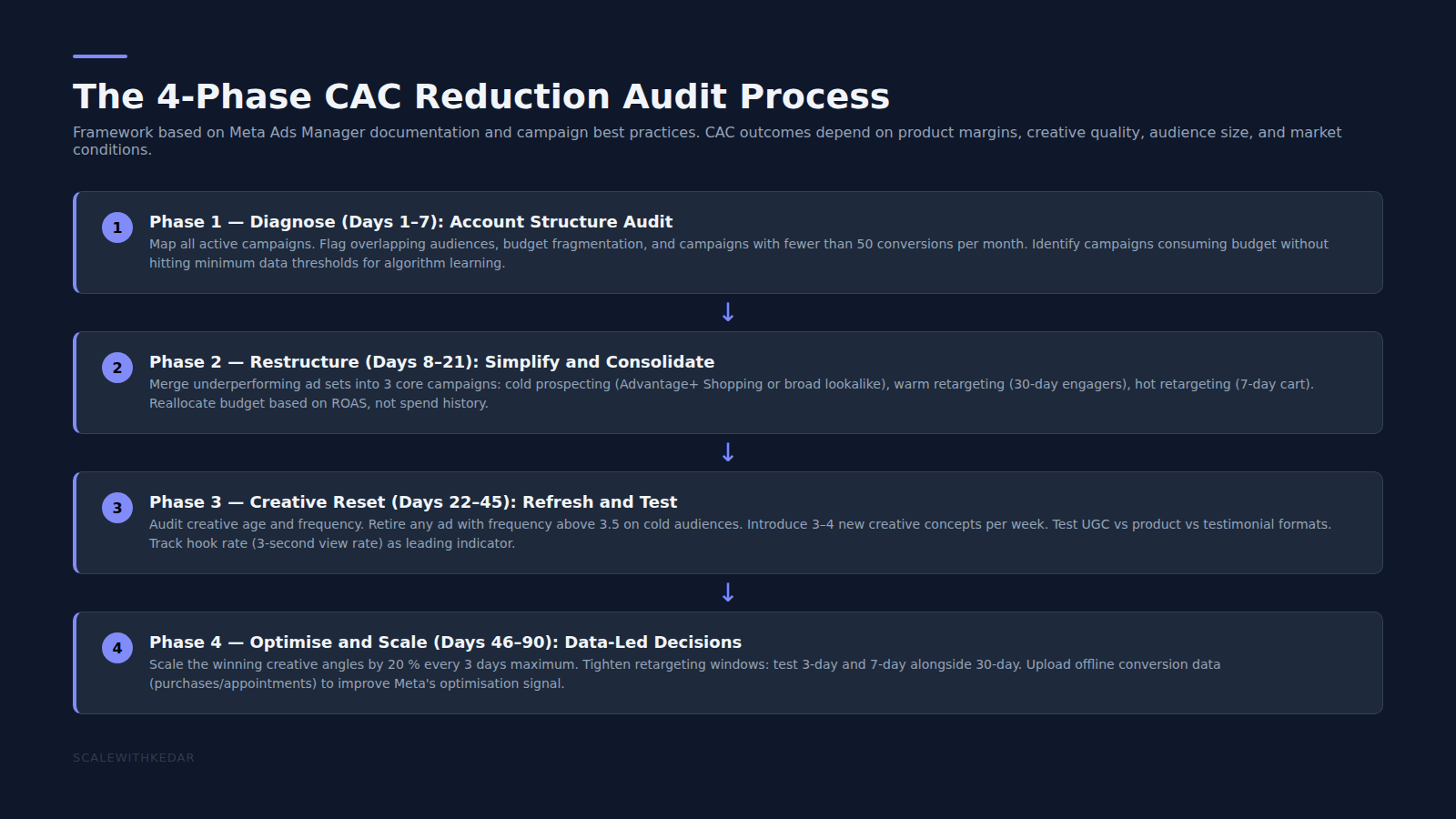
- If CPM is high relative to industry benchmarks: The issue is audience efficiency. You’re reaching the right people, but in an expensive way. Audit audience size (too small = high CPM), creative relevance score, and whether you’re competing against yourself with overlapping ad sets.
- If CTR is low (<1% for prospecting): The issue is creative. Your hook isn’t compelling enough to stop the scroll. Test new creative formats (UGC, educational content, ingredient spotlights) rather than optimising copy on a format that isn’t working.
- If CVR is low (visitors aren’t purchasing): The issue is landing page quality or offer structure. High-intent visitors who don’t convert are almost always a landing page problem: unclear value proposition, poor mobile experience, or a friction point in the checkout flow.
Diagnosing which of the three is the primary driver tells you where to invest improvement effort. Fixing CVR when CPM is the problem wastes time and budget.
Step 3: Fix the Creative Before Fixing the Audience
For skincare brands specifically, creative quality is the highest-leverage CAC lever. Skincare purchases are high-consideration — consumers want to understand what a product does, how it works, and why it’s worth the price. Creative that doesn’t address these questions doesn’t convert cold audiences efficiently.
The creative approaches that consistently reduce CAC for skincare prospecting:
- Ingredient education content: Short-form videos or carousels that explain a key active ingredient — what it does, why it matters, what results to expect — perform well in skincare because they build belief before asking for purchase intent. This format respects the decision cycle.
- Before/after content with context: Before/after imagery works if it includes context (timeline, product used, consistent conditions). Without context it reads as unverifiable, which reduces trust for ingredient-conscious consumers.
- User-generated content (UGC) style ads: First-person testimonial video consistently outperforms polished brand creative in skincare prospecting because it’s perceived as more authentic. The production quality signal matters less than the authenticity signal in this category.
- Specific skin concern hooks: Ads that open with a specific skin concern (“If you’ve tried everything for hyperpigmentation…”) outperform generic benefit claims (“Glow from within”) because they immediately qualify the viewer and signal relevance.
Step 4: Optimise the Post-Click Experience
A well-structured creative that lands on a poor product page is a wasted click. For skincare, the post-click experience has specific requirements:
- Ingredient transparency: List active ingredients prominently and link to or summarise what each does. Skincare consumers increasingly research ingredients before purchasing — addressing this on-page reduces the need to leave and research elsewhere.
- Skin type compatibility: Explicitly state which skin types the product is formulated for. Ambiguity increases buyer hesitation and return rates.
- Social proof at decision points: Reviews and UGC should appear close to the add-to-cart CTA, not buried at the bottom of the page. A customer on mobile who scrolls past reviews without seeing them is a missed conversion.
- Risk reversal: Free returns, satisfaction guarantees, or a “try before you commit” offer (sample sizes, starter kits) reduce purchase friction for first-time buyers. These are particularly effective for skincare where product fit depends on skin type.
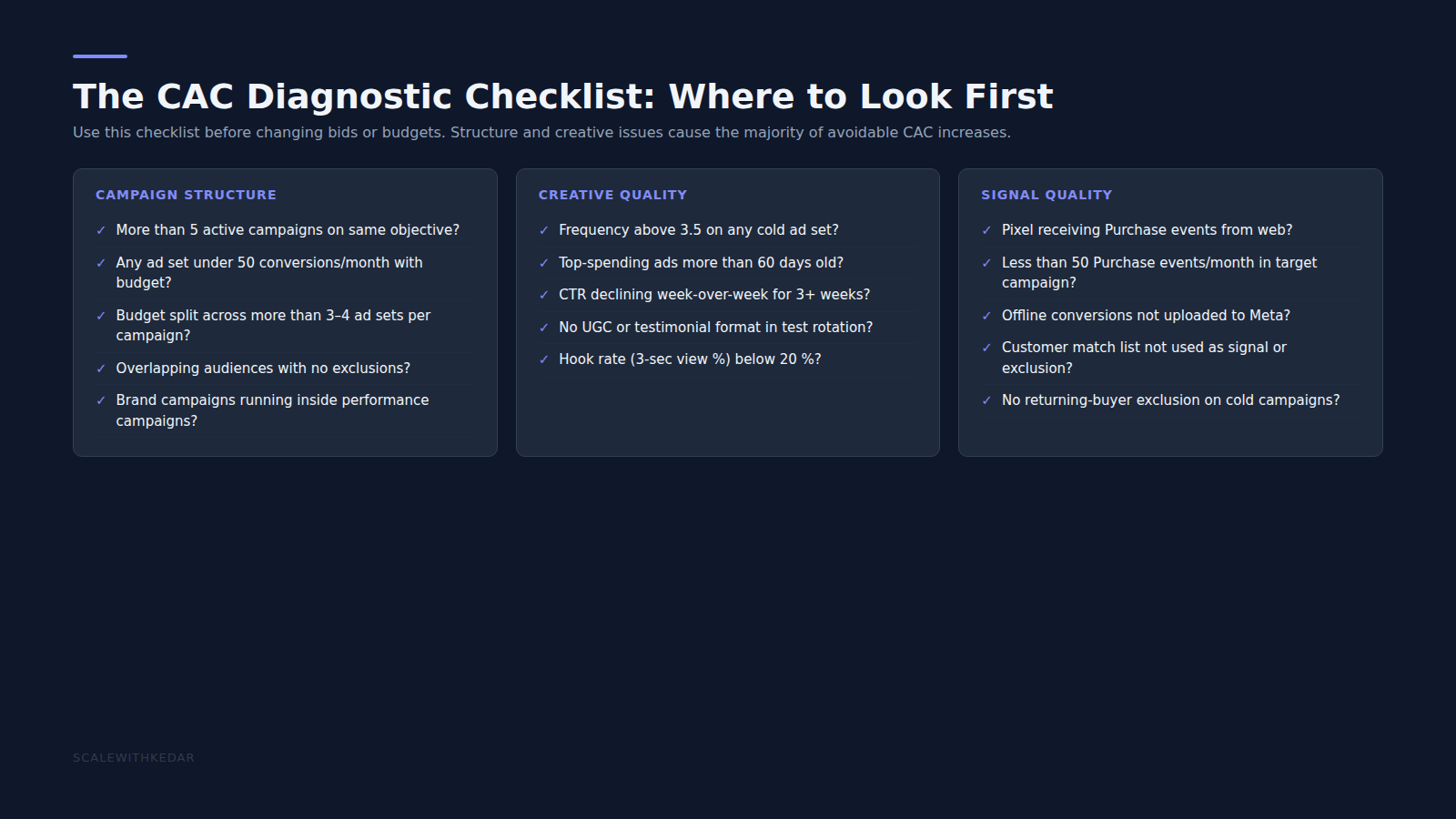
Step 5: Build Retention to Reduce Effective CAC
The most sustainable way to reduce net CAC is to increase LTV so that a given acquisition cost becomes a smaller fraction of total customer value. For skincare brands, LTV is primarily driven by two things: repurchase rate and average order value on repeat purchases.
The retention mechanics that have the highest impact on effective CAC:
- Post-purchase email sequence: A structured 90-day post-purchase email flow that includes product education, routine building, and timely repurchase prompts is the single highest-ROI retention lever for skincare. Most brands have generic welcome sequences; few have sequences genuinely built around product usage and results timelines.
- Subscription conversion: Converting single-purchase customers to subscription dramatically improves LTV. The conversion is most effective when offered at the moment of repurchase intent (not at initial checkout) — a repurchase email with a clear “subscribe and save” option timed around the expected product finish date.
- Bundling for AOV: Cross-sell at checkout and in post-purchase emails using routine-based logic (“complete your AM routine with…”) increases AOV on repeat purchases without increasing prospecting spend.
CAC climbing without an obvious cause?
A structured account audit identifies whether the driver is CPM (audience or competition), CTR (creative), CVR (landing page), or attribution (inflated baseline). We return a specific action plan with prioritised fixes, not a generic performance review.
The Compounding Benefit of Getting All Five Steps Right
These five levers don’t work in isolation — they compound. A 10% improvement in CTR, combined with a 10% improvement in CVR and a 15% increase in LTV from better retention, produces a structural CAC improvement that no single lever could achieve alone. The brands that sustain low CAC over time aren’t the ones that found one winning creative — they’re the ones that built a system where each layer of the funnel is measured, maintained, and improved continuously.
For the audience-building frameworks that feed the top of this system, see our guide to Meta Lookalike Audiences for DTC prospecting. For the campaign architecture that structures the middle, see our Meta Ads campaign structure framework. For the creative strategy that drives the CTR lever, see our Meta Ads creative strategy guide.
Sources and Further Reading
- WordStream: Facebook Ads Benchmarks by Industry — CTR and CPM benchmarks useful for establishing your baseline against industry averages.
- Think with Google: Beauty and Skincare Consumer Journey Research — research on how skincare consumers research, evaluate, and purchase online.
- Meta for Business: About Lookalike Audiences — building prospecting audiences from your purchaser seed for efficient new customer acquisition.