
Why Most DTC Brands Get Their Ad Budget Wrong
If you’re running a US DTC brand and you’ve been splitting your ad budget by gut feel — a bit more to Meta when sales dip, a Google campaign because your competitor seems to be running one — you’re leaving real money on the table. DTC ad budget allocation is one of the most consequential decisions an ecommerce founder makes, and yet most brands treat it like an afterthought.
This guide breaks down a practical, data-informed channel-mix framework you can apply to your brand right now. No fluff, no vague advice. Just a clear way to think about where your dollars should go in 2026.

The Core Principle: Budget Follows Funnel Stage
Before you assign dollars to any channel, understand what each channel is actually good at. Meta and TikTok drive awareness and top-of-funnel demand. Google Shopping and Performance Max capture existing demand. Email and SMS convert and retain. Trying to make Meta perform like Google, or email perform like TikTok, is how brands burn budget.
The fundamental rule: allocate budget where each channel has the highest ROI for its natural job — not where you hope it will perform.
The 2026 Channel Mix Framework for US DTC Brands
Here’s a starting allocation framework based on where US DTC brands with $50K–$500K/month in revenue are typically finding their strongest returns. Treat this as a baseline, not a prescription:
Meta Ads: 35–45% of Paid Budget
Meta (Facebook + Instagram) remains the most powerful demand-generation engine for most US DTC categories, especially in home, beauty, food & bev, and apparel. Broad targeting, advantage+ campaigns, and strong creative output drive new customer acquisition at scale.
- Best for: Prospecting, retargeting, and driving first purchase
- Healthy benchmark: 2–3x blended ROAS for new customer acquisition in competitive categories
- When to increase: When you have strong creative assets and LTV data justifying higher CAC
If you haven’t built a proper creative testing structure yet, read this guide on Meta Ads creative testing for DTC brands before scaling spend.
Google Ads (Shopping + Performance Max): 25–35%
Google is where your bottom-funnel demand goes. Shoppers who already know what they want — searching “best collagen peptides USA” or “organic cotton sheets queen” — are ready to buy. If you’re not capturing that intent, a competitor is.
- Best for: Bottom-funnel demand capture, product-specific intent
- Healthy benchmark: 4–8x ROAS on Shopping; Performance Max blended 3–5x
- Key setup: Feed quality matters enormously — invest in it
If you’re running Performance Max, make sure you’ve properly set up asset groups and audience signals before throwing budget at it.
TikTok Shop / TikTok Ads: 10–20%
For brands in categories with strong visual or entertainment appeal — food, beauty, fitness, home — TikTok is a legitimate growth channel in 2026, not just an experiment. TikTok Shop in particular is collapsing the funnel: discovery and purchase happen in the same session.
- Best for: Gen Z + Millennial audiences, impulse-buy categories
- Allocation note: Start at 10% and scale based on data, not hype
- Warning: Content requirements are high — native-feeling video or performance drops sharply
Email & SMS: 5–10% (but return is disproportionate)
This is the most underinvested channel in most DTC budgets. Email and SMS don’t require the same media spend as paid channels, but they do require investment in tools, strategy, and copy. The return is often 30–40x for owned list revenue — making this the highest-ROI channel in your stack when done well.
- Best for: Repeat purchases, LTV expansion, win-back, loyalty
- Tool investment: Klaviyo ($300–$2K/month depending on list size) is the standard for US DTC
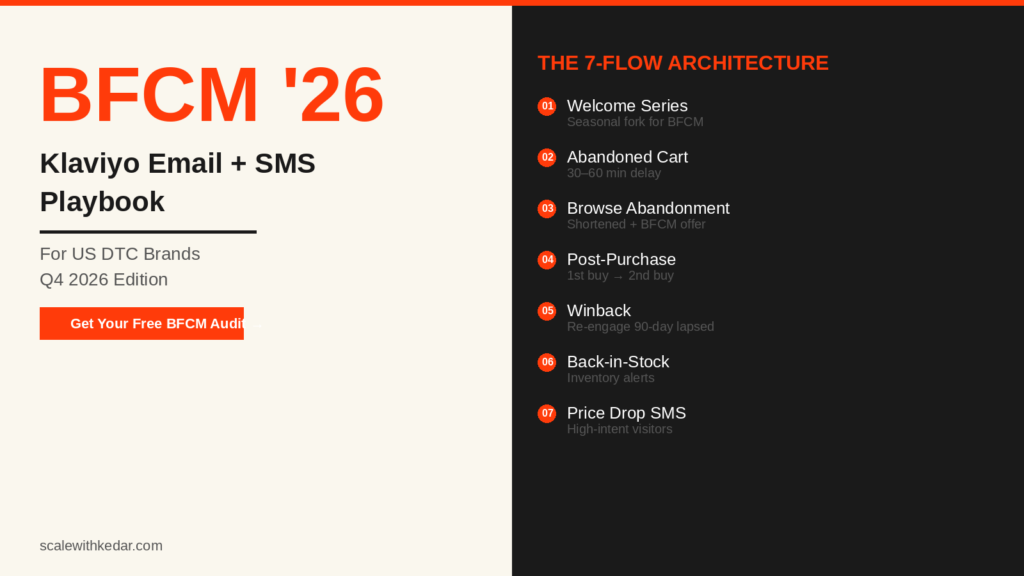
- Key flows: Welcome, abandoned cart, post-purchase, browse abandonment, win-back
Influencer / UGC: 5–10%
This allocation is for paid partnerships and UGC production — content that feeds your Meta and TikTok ads as much as it generates organic reach. Think of influencer budget less as media spend and more as creative production with distribution built in.
How to Adjust the Mix for Your Stage
Early Stage ($10K–$50K/month revenue)
Concentrate 70–80% of paid budget on one or two channels. Spreading too thin means you never build the data needed for algorithmic optimisation. Most early-stage brands should start with Meta-only or Meta + Google Shopping until you hit $30K/month in revenue. Every channel you add before you’re profitable on the first two dilutes focus and data.
Growth Stage ($50K–$250K/month)
This is where the framework above applies most cleanly. You have enough data to run proper attribution, test channels, and make informed allocation decisions. Key priority at this stage: make sure you’re measuring properly. If your GA4 attribution is broken, you’ll misallocate and wonder why ROAS is declining.
Scale Stage ($250K+/month)
At scale, efficiency is the game. You’ve likely saturated your best audiences at current spend levels. This is when CRO, LTV strategy, and product page conversion rate matter as much as media buying. Shifting 5% of ad spend into improving conversion can outperform adding 20% to Meta budget.
The Attribution Problem Every DTC Brand Faces
Here’s the honest truth: in 2026, perfect attribution doesn’t exist. iOS tracking limits, cross-device behaviour, and multi-touch journeys mean that every channel takes partial credit for every sale. Your job isn’t to find perfect attribution — it’s to triangulate well enough to make better decisions than your competitors.
Practical approach:
- Run a Meta Ads holdout test quarterly to measure true incrementality
- Use Media Mix Modelling (MMM) if you’re above $200K/month in spend
- Track blended CAC (total ad spend ÷ new customers) alongside channel ROAS
- Don’t cut a channel based on one bad week — look at 30-day and 90-day trends
A Red Flag: When Your Budget Mix Is Off
Watch for these signals that your allocation needs rebalancing:
- Blended ROAS rising but new customer count falling: You’re over-investing in retargeting (re-selling to existing customers) and under-investing in acquisition
- High Meta spend with no Google Shopping: You’re paying to create demand that competitors are capturing
- No email/SMS investment: You’re relying entirely on paid to drive repeat purchases — expensive and fragile
- Spending on 4+ paid channels below $50K/month revenue: You’re too thin to optimise any of them
Three Budget Reallocation Triggers Worth Watching
Tactical allocation shifts shouldn’t happen weekly — but there are three performance signals that warrant immediate re-evaluation of your channel mix:
- New customer CAC rising more than 20% month-over-month on Meta: Audience saturation or creative fatigue. Before cutting spend, test fresh creative angles. If CAC stays elevated with new creative, shift 10–15% to Google Shopping or test a new channel.
- Google Shopping impression share dropping below 60%: You’re losing ground to competitors on demand you’ve already primed. Increase bids or improve your product feed quality score — this is usually a fixable issue, not a reason to abandon the channel.
- Email revenue per recipient declining for 90+ days: Your list is aging or over-sending. This is a segmentation and send-frequency problem. A re-engagement campaign and a list hygiene pass often recover 20–30% of lost revenue without spending a dollar in paid.
Treat these as early warning systems, not emergencies. Most DTC performance issues are recoverable if caught at the first signal rather than after three months of wasted spend.
Final Thought: Budget Allocation Is a Quarterly Decision
Your channel mix should change as your brand scales, as seasonality shifts, and as the platforms evolve. Set a quarterly allocation review as a standing meeting. Pull channel performance, benchmark CAC and ROAS against your targets, and make adjustments with data — not panic or habit.
The brands that win at DTC aren’t the ones with the biggest budgets. They’re the ones who deploy dollars where they compound most effectively, and who adjust faster than their competitors when the data changes.
If you want a second pair of eyes on your current channel mix, book a strategy call — I work with US DTC founders to audit paid media allocation and find the gaps that are holding back growth.