
Header image: Original AI-generated editorial illustration of ecommerce planning.
For a US DTC brand, Q4 audience segmentation should connect customer evidence to useful creative and measurable acquisition decisions. Start with your purchase history, recent website activity and campaign objectives. Then distinguish audiences that restrict delivery from signals that guide automated campaigns. Use your own margins, conversion lag and experiment results to set budgets; a fixed percentage split or bid increase cannot establish what will be profitable for your store.
This is a researched planning framework, not a report of client results. The examples below are hypothetical. Official platform sources were checked on October 11, 2026; available settings should also be verified in your account before implementation.
Start with four customer questions
The four groups below help organize messaging and measurement. They are not automatically four separate campaigns. A person can appear in several lists, and unmatched or missing data means that “not in the customer list” does not prove someone has never encountered your brand.
| Group | Evidence to use | Creative hypothesis | Decision to measure |
|---|---|---|---|
| Prospective customers | No purchase identified in your available first-party data | Explain the product, its use and the problem it addresses | New-customer acquisition cost and contribution after advertising |
| Recent engagers | Recorded website or social engagement, with no purchase identified | Demonstrations, useful comparisons and authentic customer evidence | Purchase outcomes after the normal conversion lag |
| Cart or checkout visitors | A recorded cart/checkout event without a subsequent recorded purchase | Clarify delivery, returns, product fit or another evidenced objection | Incremental recovery where measurable, rather than attributed ROAS alone |
| Existing customers | Verified purchase history, replenishment needs or relevant product ownership | Relevant replenishment, complementary products or a real loyalty benefit | Repeat-purchase contribution and incremental response |
Prepare the data before creating more campaigns
- Check that purchase events, values and customer status agree with your store’s order records. Record gaps and differences between platform attribution and store revenue.
- Choose audience windows from your buying and replenishment cycles. A 30-day cart list or 90-day visitor list is a possible test definition, not a universal recommendation.
- Where the platform supports strict segment controls, make your intended groups consistent: for example, remove recorded purchasers from a cart-recovery group. Check overlap and list freshness.
- Use customer data you are permitted to use for advertising. Google’s Customer Match policy requires first-party collection, appropriate disclosures and consent where required; available targeting features also depend on account eligibility. A captured checkout email alone is not sufficient justification to upload a list.

Build a Meta plan around the controls available in your account
Meta’s campaign setup has evolved. Its official Q2 2025 update describes the global rollout of streamlined sales and app campaign creation with Advantage+ enabled from the beginning. Do not assume that an older manual-versus-shopping tutorial matches the settings you see today.
- Define the commercial objective. Decide whether the campaign is intended to acquire customers, recover eligible abandoned carts or sell a relevant follow-on product. Keep purchase measurement aligned with that objective.
- Inspect audience settings before naming a campaign “retargeting”. Record which inputs are suggestions, which controls restrict delivery and which customer exclusions are actually applied. An audience label alone does not prove that delivery is confined to that group.
- Use a structure the available data can support. Separate groups when the objective, creative, controls or measurement require it. Avoid forcing every group into another ad set when that would divide an already small conversion sample.
- Treat prospecting approaches as tests. Broad audiences and customer-based lookalikes are alternative hypotheses. Use a relevant, accurate seed when testing lookalikes; neither a 1% audience nor a larger percentage is inherently the Q4 winner.
Use genuine offers and substantiated customer stories. Product demonstrations, static images and video are formats to test against your objective; this framework does not claim that one format universally outperforms another.
Use the right Google Ads mechanism
Search: observation and targeting serve different purposes
Observation lets you analyze an audience without narrowing campaign reach. Targeting restricts reach. Choose deliberately: an observation list is not a remarketing-only campaign. Google also explains that first-party audience segments under Observation can provide signals to Smart Bidding.
Do not apply a blanket +20–40% audience bid increase. With Target ROAS, existing bid adjustments are not used, apart from a device exclusion of -100%. For another bidding strategy, check its documented eligibility before using an adjustment and base any test on your account evidence.
Performance Max: audience signals guide delivery
Google describes Performance Max audience signals as optional suggestions. Ads can reach people outside those signals. A warm visitor list or in-market input does not create a strictly isolated cold, warm or cart-abandoner campaign.
If customer acquisition is the objective, review the new customer acquisition goal, its available bidding mode, customer identification and purchase tracking. Use current customer lists and check match quality. Do not describe a signal list as a purchaser exclusion or assume that every customer will be identified correctly.
Customer Match: confirm permission, eligibility and matching
Prepare an appropriate first-party customer list, check which campaign features your account can use and inspect processing and matching results. Follow the documented Customer Match workflow. List availability, campaign targeting and automated customer-identification goals are distinct parts of the setup.
Allocate budget using economics and evidence
Begin with your expected contribution after product cost, fulfillment, payment fees, discounts and expected returns. Set an acquisition constraint, an affordable test budget and a review rule that allows for conversion lag. Budget percentages across prospecting and retention should follow the opportunity and the data; there is no universal 40/30/20/10 split.
Hypothetical example: An order brings in $100 and contributes $40 before advertising after the costs above. Spending $40 to acquire that order would use the entire first-order contribution; the corresponding revenue-to-ad-spend ratio is 2.5x. This simplified calculation is not a campaign target or a client result. Repeat value, incrementality, overhead and reporting differences can change the decision.
- Document what would justify more spend: for example, sufficiently mature new-customer results that meet your contribution constraint.
- Check whether a small retargeting pool can absorb additional spend without simply reaching the same people more often.
- Review inventory, real delivery commitments and landing-page performance before expanding a promotion.
- Separate attributed purchases from incremental growth. Strong retargeting ROAS can reflect customers who would have purchased without another ad.
Need help reviewing these decisions? Request a Q4 audience-plan discussion with Kedar. Include your store URL, target market, ad platforms and the measurement or acquisition problem you want to solve.

Match creative to a question, then test the answer
For a prospective customer, test a clear product demonstration or use case. For an engaged visitor, test evidence that addresses an observed question. For a checkout visitor, explain actual delivery terms, returns or product fit. For a customer, show a relevant next purchase or a real loyalty benefit. These are starting hypotheses, not guaranteed winners.
Test one meaningful change where practical, keep the offer and measurement clear, and compare results after the relevant conversion lag. Use only truthful testimonials and documented before-and-after claims. A deadline, stock warning or discount should reflect the actual offer.
Four stages as a planning illustration
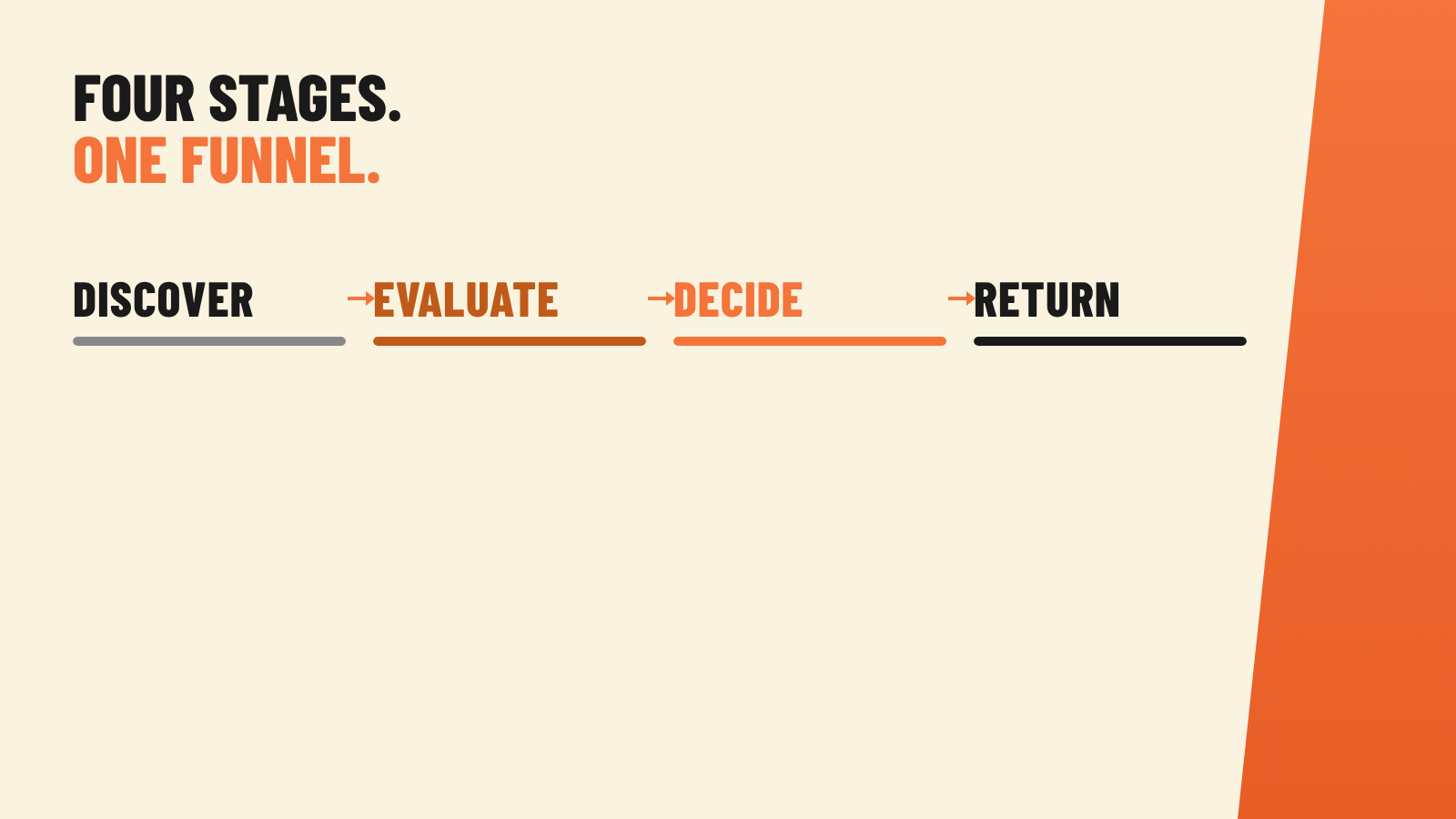
The motion illustrates Discover → Evaluate → Decide → Return. Its filling bars and arrows show a planning sequence; they are not measured audience sizes, conversion rates, performance scores or budget allocations. People can skip or repeat stages.
Text explanation of the animation: The four labels stay in place while bars fill and arrows connect them in sequence. Use the questions below to plan messages, then evaluate them against your actual customer data and campaign controls.
- Discover: explain what the product does and the problem it addresses.
- Evaluate: offer a truthful demonstration, useful comparison or evidence that addresses an observed question.
- Decide: clarify real delivery, returns, product fit or another documented purchase objection.
- Return: consider a relevant next purchase or genuine loyalty benefit using verified purchase history.
A Q4 readiness checklist
- Measurement: Validate purchase events, values, customer identification and known attribution gaps.
- Audience definitions: Document data source, recency, matching limitations and controls for each intended group.
- Campaign mechanics: Verify Meta delivery settings, Google’s observation/targeting distinction, bidding strategy and Performance Max goals.
- Creative and operations: Confirm accurate product claims, current offers, inventory and delivery terms.
- Decision rules: Record the baseline, test hypothesis, economic constraint and when results will be mature enough to review.
Schedule these checks before the promotion rather than treating October 15 or November 1 as universal readiness deadlines. List processing, creative production and conversion lag differ between stores.
Questions founders should resolve before scaling
Should every customer stage have its own campaign?
No. Separate stages only when the available campaign controls, objective, creative or measurement make that useful. Keep the structure manageable for your conversion volume.
Does a Performance Max cart signal restrict delivery to cart visitors?
No. Signals are suggestions and delivery can extend beyond them. Use the appropriate campaign features for the actual objective.
What is a good Q4 ROAS?
Use your contribution economics, acquisition objective and measurement limitations. A platform ratio alone does not establish profitability or incremental sales.
Request a plan for your store
If you are a US ecommerce founder or marketing lead, send Kedar a Q4 audience-plan inquiry. Share your store URL, channels, approximate media-spend range and main bottleneck so the discussion can focus on your situation. You can also review the available performance marketing services.