If you run a DTC brand in the US, Q4 is the quarter that makes or breaks your year. Black Friday, Cyber Monday, and the Christmas gifting window can account for 30–40% of annual revenue — but only if you start planning in September. This week-by-week Q4 holiday marketing calendar gives you a clear action sequence across email, paid media, and SMS so you stop reacting and start executing with confidence.
Why Q4 Planning Has to Start in September
Most DTC founders underestimate lead time. Your Meta and Google campaigns need 2–3 weeks of learning data before you hit peak spend. Your creative production — video ads, email banners, product photography — takes another 2–4 weeks. Your email list needs warming before you can send 5x/week in November without killing your deliverability. Start in September and you’ll have margin for mistakes. Start in October and you’ll be improvising during your highest-traffic window.
The Week-by-Week Q4 Holiday Marketing Calendar
September: Foundation and Creative Production
Weeks 1–2 (Sept 1–14) — Audit and Plan
- Pull last year’s Q4 numbers: ROAS by channel, email revenue share, top-selling SKUs, CAC vs. AOV
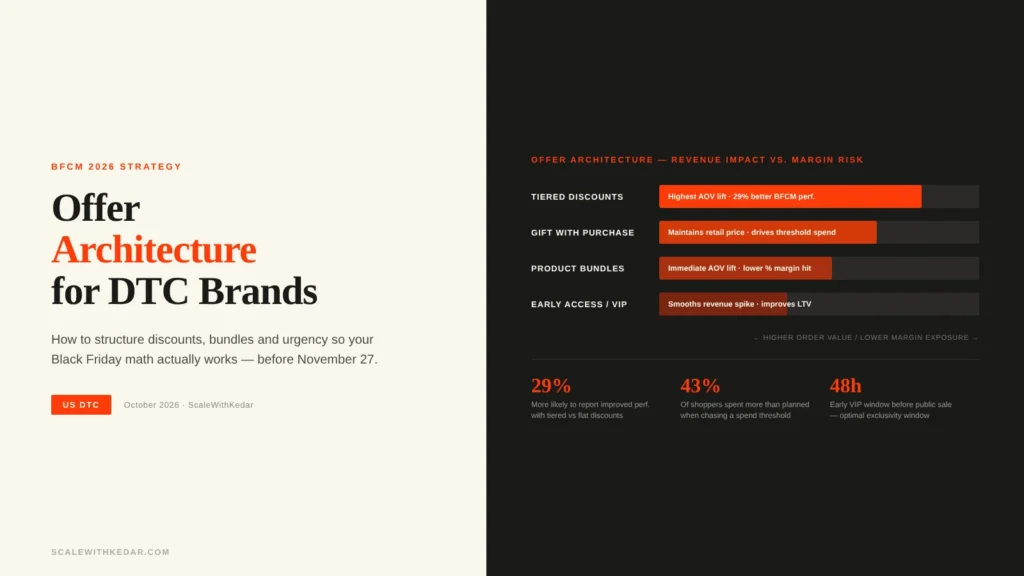
- Decide this year’s offer structure: flat discount, BOGO, bundle, free gift with purchase
- Lock your creative brief — hooks, product hero angles, UGC assets you’ll need
- Check your checkout flow for any friction you haven’t fixed yet
Weeks 3–4 (Sept 15–30) — Creative Production and List Warming
- Begin creative production for Black Friday / Cyber Monday assets
- Launch a re-engagement campaign for cold email subscribers (anyone who hasn’t opened in 90+ days)
- Set up SMS capture if you haven’t — you want 4–6 weeks to build your list before BFCM
- Install and test tracking pixels; verify UTM parameters on all paid campaigns
October: Build Audiences and Start Testing
Week 1 (Oct 1–7) — Top-of-Funnel Expansion
- Launch broad Meta Ads campaigns to build your remarketing audience — you need site visitors before you can retarget them
- Begin Google Shopping campaigns; give them 3 weeks to build conversion data before BFCM
- Send a “Halloween preview” email to tease upcoming offers and re-engage your list
Weeks 2–3 (Oct 8–21) — Creative Testing and Segmentation
- Test 3–5 creative variants at moderate spend — you’re looking for your top 2 performers to scale in November
- Segment your email list: VIPs (repeat buyers), engaged subscribers, cold subscribers
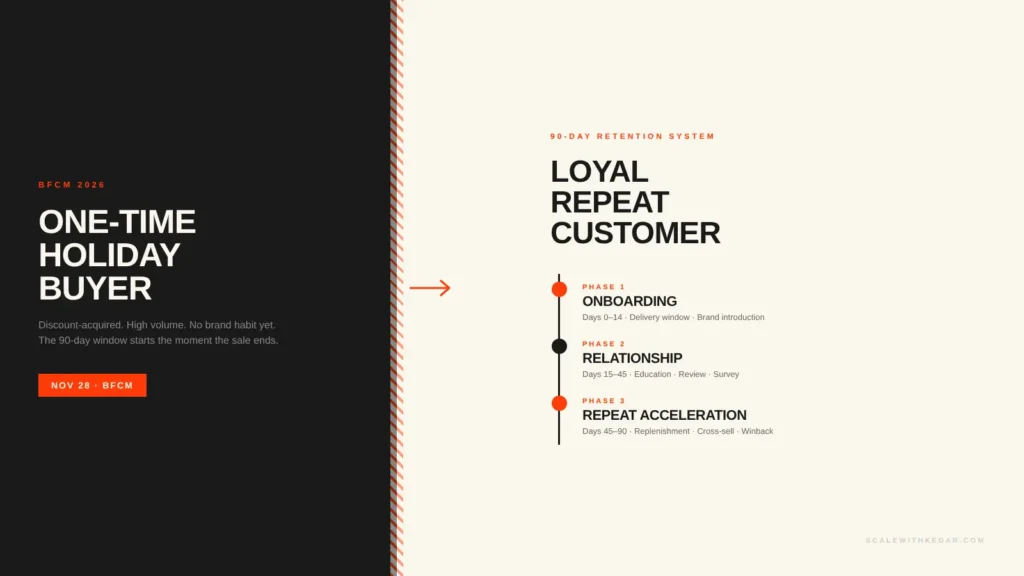
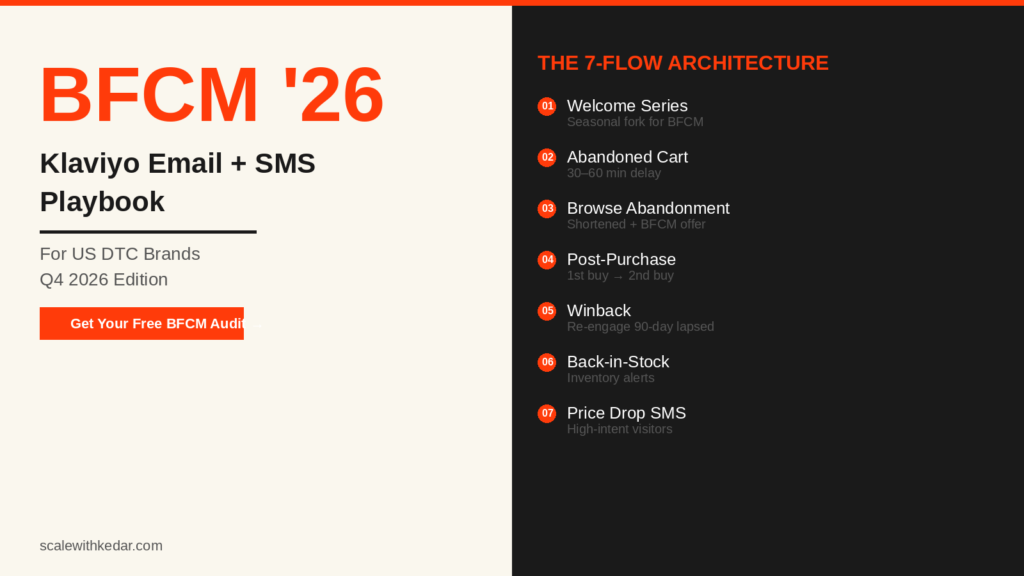
- Make sure abandoned cart and browse abandonment flows are live — these compound over Q4
- Review your Klaviyo email flows and update copy for the holiday season
Week 4 (Oct 22–31) — Halloween + BFCM Teaser
- Run a Halloween flash sale or bundle if it fits your brand — this is a low-pressure revenue window
- Launch a “BFCM early access” sign-up: email or SMS capture gated to your offer preview
- Freeze creative testing by Oct 31 — give your top creatives 2 weeks of clean data before you scale
November: The BFCM Revenue Window
Week 1 (Nov 1–7) — Final Preparation
- Sign off on all creative — no new testing from here to Dec 1
- Write and QA every email in your BFCM sequence: VIP early access, main launch, urgency day-2, last chance
- Brief customer service on expected volume and your refund/exchange policy
Week 2 (Nov 8–14) — Pre-BFCM Warm-Up
- Ramp paid media spend 20–30% to build momentum
- Send 2–3 teaser emails to your full list
- Optional: Veterans Day (Nov 11) flash sale for brands where it aligns naturally
Week 3 (Nov 15–21) — Pre-Black Friday
- Send “We’re going live soon” email and SMS to your lists
- Increase ad frequency on warm audiences — people seeing you more often before the offer lands convert better
- Send an early access email to your VIP/repeat buyer segment 24–48 hours before the main sale
Week 4 (Nov 22–28) — Black Friday (Nov 28, 2026)
- VIP email: Send 48 hours before launch; let repeat buyers shop first
- Launch day: Send your main offer email at 6am ET; follow with a lunchtime reminder
- Paid media: Go to maximum budgets with your top 2 proven creatives
- Abandon cart: Shorten to 1-hour trigger during BFCM; people are comparing across many brands
Week 5 (Nov 29 – Dec 1) — Cyber Monday (Dec 1, 2026)
- Send “last chance” emails Sat + Sun evening for BFCM stragglers
- Cyber Monday: either extend the same deal or pivot to a different offer (free shipping, exclusive bundle)
- Retarget everyone who visited but didn’t purchase during Black Friday
December: Christmas and Year-End Close
Week 1 (Dec 1–7) — Gifting Pivot
- Wind down heavy discounting — protect your margin
- Pivot all messaging to gifting: “perfect gift for…”, “they’ll love it”
- Continue email at 3x/week; go back to standard send frequency
Week 2 (Dec 8–14) — Last-Minute Gifting Push
- Lead with a specific shipping deadline: “Order by Dec 18 for guaranteed Christmas delivery”
- Offer expedited shipping as an upsell at checkout
- Paid media targeting gift shoppers with “Ships by Christmas” creative
Week 3 (Dec 15–21) — Final Holiday Window
- Send your last guaranteed delivery date email — this creates real, honest urgency
- If you offer digital gift cards, pivot your homepage and ads to feature them after Dec 18
- Wind down paid media spend; CPC climbs and ROAS drops in the final days before Dec 25
Week 4 (Dec 22–31) — Year-End Wind-Down and New Year Setup
- Run a “New Year, New Start” offer or product bundle in the last week
- Send a 1-question survey to Q4 buyers — what made them buy, what they’d buy next
- Pull your Q4 performance report: channel revenue breakdown, new vs. returning customer split, email list growth
The Three Channels That Move the Needle in Q4
Email: Your Highest-Margin Channel
Most DTC brands underutilise email in Q4. You can send 5–7x per week in the BFCM window without hurting deliverability — if you’ve warmed your list properly. Segment ruthlessly: VIPs, engaged, and cold subscribers should get different messaging and different send times. See the full DTC Q4 email marketing playbook for sequence templates.
Paid Media: Meta First, Google Second
For most consumer DTC brands, a 70/30 split between Meta and Google Shopping is a reasonable starting point. Meta drives discovery; Google captures demand that already exists. Use October for creative testing and October 31 as your freeze date. During BFCM, run only your proven top performers — this is not the time to test new hooks. For a deeper breakdown, the Meta Ads ROAS optimisation guide covers the budget and audience strategy in detail.
SMS: Sparingly, High-Intent Only
SMS gets the highest open rates of any channel in Q4 — but overuse it and your unsubscribe rate spikes. Limit yourself to 2–3 sends in the BFCM window: VIP early access, offer launch, and final-hours urgency. Keep copy short and the offer crystal clear. Every SMS should have one link, one action.
If You’re a Small Team: What to Prioritise
If you’re operating with a team of 1–3, don’t try to activate everything. In order of impact: email flows first (set and forget), paid media second (requires active management), SMS third (high ROI for small send volume). Skip influencer campaigns and affiliate launches in Q4 unless they’re already running — launching new channels during your peak traffic window adds complexity without guaranteed return.
Pre-Launch Checklist
- Creative reviewed, uploaded, and live in Ads Manager
- Email sequences tested in staging and scheduled
- Tracking pixels verified; UTM parameters on all links
- Checkout tested on mobile with holiday offer applied
- Customer service briefed on offer terms and return policy
- Inventory counts confirmed with fulfilment team
Start Now — September Is Not Too Early
Every week of preparation you do in September is a week you won’t be scrambling in November. The brands that consistently win in Q4 aren’t the ones with the biggest budgets — they’re the ones who show up with better creative, better-segmented lists, and fewer technical surprises. If you want a hand reviewing your current Q4 plan or building one from scratch, reach out through the ScaleWithKedar contact page — I work with a small number of US DTC brands each quarter on exactly this.