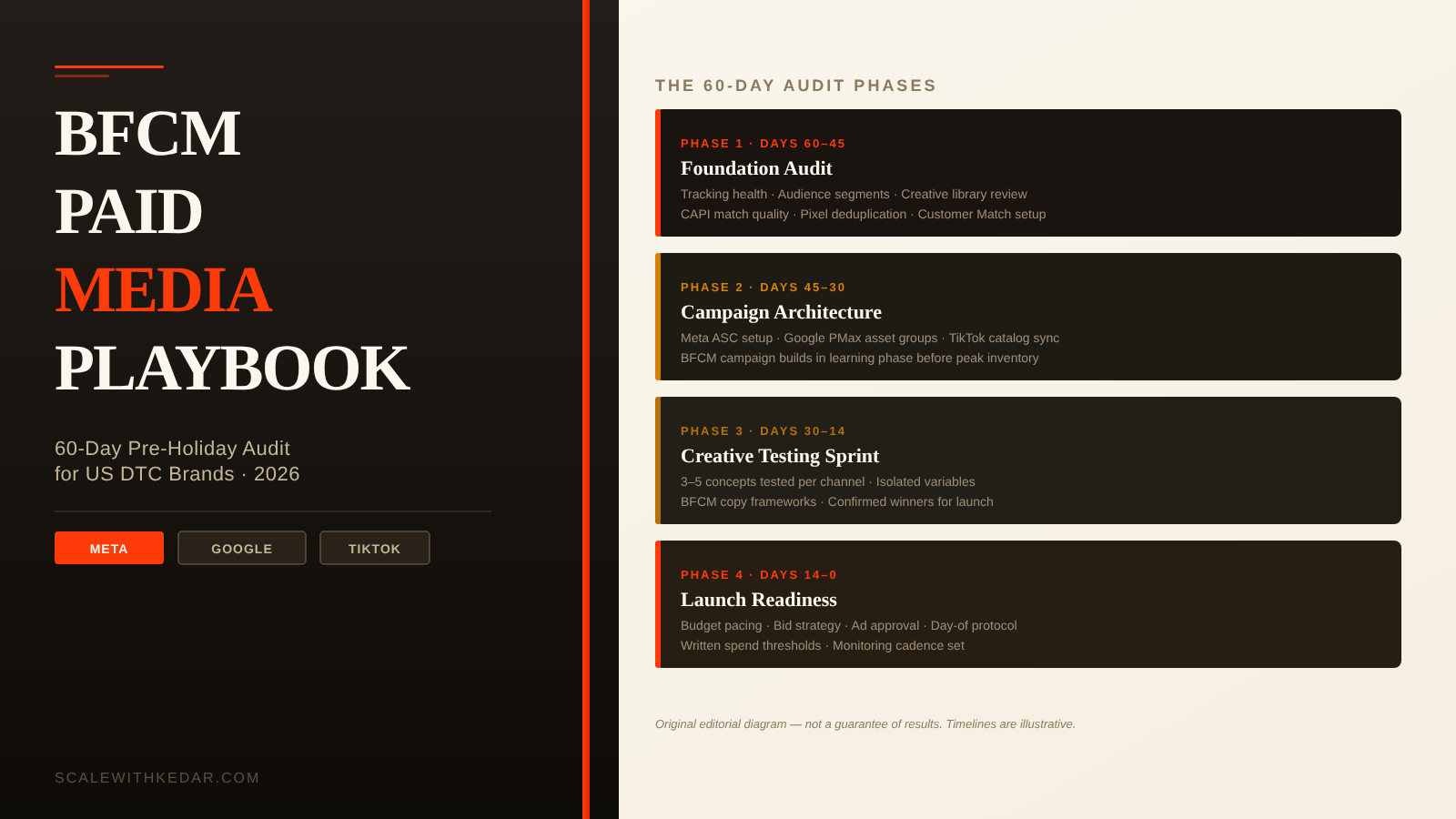
Black Friday and Cyber Monday arrive in six weeks. For US DTC brands running paid media on Meta, Google, and TikTok, the decisions you make in October determine whether Q4 is your best quarter or your most expensive one. This audit checklist breaks the 60-day pre-BFCM window into four phases: foundation, architecture, creative testing, and launch readiness. Work through it in order — gaps found at day 14 are far harder to fix than gaps found at day 60.
Why the 60-Day Window Is the Actual Leverage Point
Platforms take three to five weeks to exit the learning phase on new campaign structures. Meta’s Advantage+ Shopping requires two to three weeks of purchase events before optimization stabilizes. Google Performance Max needs sufficient conversion history before Smart Bidding can model your Q4 audience. Starting campaign structure changes in November means you are paying peak CPMs for unstable optimization. The window from mid-October to early November is where Q4 outcomes are largely decided.
Phase 1: Foundation Audit (60–45 Days Out)
Tracking and Measurement Health
Run a complete pixel and Conversions API health check before you touch campaign structure. Confirm:
- Purchase event deduplication rate is below 20% in Events Manager
- CAPI is sending browser, server, and (where available) offline event matches
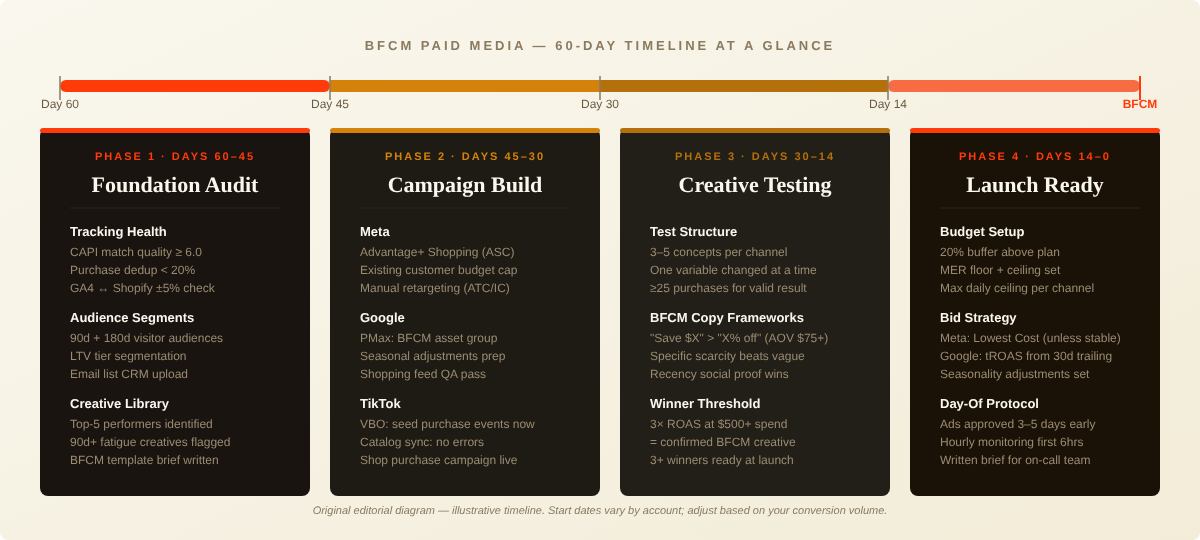
- Event match quality score for Purchase is 6.0 or above
- Google Ads conversion tracking is recording confirmed purchase conversions, not just “add to cart” as the primary conversion
- Google Analytics 4 purchase events match Shopify orders within ±5% (reconcile the gap — do not assume it is rounding)
- TikTok pixel fires on order confirmation with value, currency, and content_id populated
If your CAPI match quality is below 6.0, fix it now. A match quality score of 5.0 versus 7.0 translates to measurably worse BFCM auction performance because your bid model is operating on fewer matched events.
Audience Segment Audit
Review your Q4 audience segments against current list sizes. BFCM-specific audiences to confirm are ready now:
- All visitors 90-day and 180-day custom audiences (check recency — a 90-day window built today will naturally shift to an October–November window by the time you launch)
- Add-to-cart and initiate-checkout 30-day and 60-day audiences
- Customer LTV tiers: high-LTV repeat buyers, one-time purchasers, and lapsed customers (90+ days since last purchase)
- Email list uploads — match your full customer list and ensure CRM suppression lists are current
- Lookalike audiences seeded from your highest-LTV customer segment, not just all purchasers
For Google, confirm your in-market audiences and Customer Match lists are attached to your Performance Max asset groups. Customer Match requires verified account status; confirm this well before BFCM.
Creative Library Audit
Audit every ad currently in your account by performance quartile. Identify your top-5 performing creative formats by thumbstop rate and hook-to-hold rate on Meta, and by conversion rate on Google. These carry into your BFCM creative testing as proven structural templates — you adapt the offer message, not the format.
Flag any creatives older than 90 days with declining CTR. They need refresh before BFCM inventory pressure inflates CPMs and rewards strong creative.
Phase 2: Campaign Architecture (45–30 Days Out)
Meta Campaign Structure for BFCM
Build your BFCM campaign structure now so the learning phase completes before peak inventory demand. A proven structure for US DTC brands in 2026:
- Advantage+ Shopping Campaign (ASC): Single campaign for prospecting + retargeting blended. Set a 10–20% existing customer budget cap to prevent overspend on audiences already in your purchase funnel. This is Meta’s recommended structure and exits learning faster than manual segmentation.
- Manual retargeting campaign: Separate ATC/IC audiences with higher-frequency caps for your 14-day and 30-day windows. Keep this running alongside ASC to protect your warmest funnel.
- Broad prospecting: If you run Broad interest targeting or rely on DABA, confirm catalog feeds are clean and product titles are accurate — a BFCM product feed error at scale is expensive.
See the Meta creative testing framework for how to structure ad set testing within this architecture without fragmenting spend.
Google Performance Max for BFCM
Your Performance Max setup should already be running with sufficient conversion history. For BFCM specifically:
- Create a dedicated BFCM asset group with seasonal headlines (“Black Friday Sale,” “Shop BFCM Deals”) that you can activate/pause without touching your evergreen asset group
- Set Seasonality Adjustments in Google Ads 2–3 days before BFCM weekend to signal expected higher conversion rates to Smart Bidding
- Confirm Shopping feed product titles include search-relevant terms — PMax heavily weights feed quality for Shopping inventory
- Add your BFCM promotional offer as a Promotion extension timed to your sale window
TikTok BFCM Setup
If TikTok is part of your paid mix, set up your TikTok Shop or website purchase campaigns now. TikTok’s Value-Based Optimization requires a minimum threshold of purchase events before it can optimize; seeding this before BFCM means you’re not starting cold in November. Confirm your product catalog sync is live and resolving without errors.
Phase 3: Creative Testing Sprint (30–14 Days Out)
This phase determines your creative winners for the BFCM launch. Run a compressed creative testing sprint with these parameters:
- Test 3–5 ad creative concepts per channel, not 15. You need clear winners, not exhaustive coverage.
- Keep variables isolated: test hook type (problem/solution, social proof, before/after demonstration) against a constant offer frame, then test offer framing against the winning hook. Don’t change multiple variables simultaneously.
- Budget threshold for a valid result: enough spend to generate at least 25–50 Purchase events per variant on Meta (lower for higher-AOV brands where data accumulates more slowly)
- Flag any creative that reaches a 3x ROAS threshold at $500+ spend as a “confirmed winner” — this is your BFCM launch creative
Write your BFCM ad copy now. The three copy elements that consistently outperform in Q4 for US DTC brands:
- Explicit savings framing: “Save $X” outperforms “X% off” for most AOV brackets above $75
- Scarcity with specificity: “Sale ends Sunday at midnight” outperforms “limited time”
- Social proof with recency signal: “4,800 US customers chose this” outperforms generic star ratings
Phase 4: Launch Readiness (14–0 Days Out)
Budget Pacing Setup
Review your budget allocation framework against your BFCM projections. Set campaign-level daily budgets with a 20% buffer above your planned daily spend — Meta and Google will pace into available budget during high-demand inventory windows. If you run lifetime budgets, confirm the schedule aligns exactly with your sale window.
Build a BFCM budget pacing spreadsheet with:
- Planned daily spend per channel
- Target ROAS / MER threshold at which you maintain spend
- Floor ROAS / MER threshold at which you scale back
- Maximum daily spend ceiling per channel (prevents accidental overspend during auction volatility)
Bid Strategy Final Check
- Meta: Switch any Lowest Cost campaigns intended for BFCM scale to Cost Cap only if you have confirmed stable CPA data from Phase 3 testing. Cost Cap on insufficient data throttles delivery when you need volume. If uncertain, stay on Lowest Cost with a monitored ceiling.
- Google: Set tROAS bid strategy anchored to your 30-day trailing ROAS, not your aspirational BFCM target. Overagressive tROAS targets cause underspend during peak auction windows.
Day-Of Protocol
- Confirm your BFCM-specific ad sets and creatives are approved — submit for review 3–5 days before launch; do not wait until the morning of Black Friday
- Set up hourly spend and ROAS monitoring in your preferred attribution tool for the first 6 hours of launch
- Brief whoever manages accounts on the exact spend ceiling and ROAS floor thresholds that trigger a manual bid adjustment — written protocols reduce Black Friday panic decisions
Post-BFCM: Protecting Margin Through Cyber Week
BFCM weekend is typically the highest-spend, highest-volume window, but Cyber Monday and the week following have lower CPMs and can deliver strong efficiency for brands that maintain their campaigns. Review MER daily — not just channel ROAS. Track your contribution margin against Q4 projections as spend accumulates so you know whether scaling spend is generating incremental profitable revenue or just incremental revenue.
Run This Audit Before It Is Too Late
The checklist above covers the tactical execution layer. What it cannot cover is the strategic layer: whether your offer architecture is differentiated, whether your funnel has conversion-rate leaks that will waste BFCM spend, or whether your attribution model is measuring what you think it is measuring.
If you want a working session to run through your specific account before BFCM — covering paid media structure, tracking health, creative gaps, and offer positioning — book a strategy call. This is not a discovery call. It is a working audit where you leave with a prioritized fix list for your actual accounts.
Who this is for: US DTC and ecommerce brands spending $20,000–$500,000/month on paid media who want an expert review before their highest-stakes week of the year.
Frequently Asked Questions
How far out should I start BFCM paid media preparation?
60 days is the practical minimum for brands running Meta and Google campaigns that need learning phase stability before peak CPMs. The most impactful window is days 60–45 for tracking and audience setup, and days 30–14 for creative testing with real purchase data.
Should I use Advantage+ Shopping or manual campaign structure for BFCM?
For most US DTC brands in 2026, Advantage+ Shopping (ASC) with a customer budget cap is the recommended structure for prospecting at scale. Manual campaigns remain useful for dedicated retargeting of warm audiences. Running both simultaneously with clear budget allocation is the standard approach for Q4.
What is a realistic BFCM ROAS target for a US DTC brand?
This depends entirely on your contribution margin, CAC payback threshold, and offer depth. A brand with 65% gross margins and a 12-month payback window can sustain a lower reported ROAS than a 40-margin brand on a 90-day payback. Use MER (media efficiency ratio) as your primary metric, not blended ROAS, to track whether BFCM spend is generating profitable revenue across all channels. Specific ROAS targets without margin context are editorial guidance, not operational benchmarks.
How do I handle creative fatigue during BFCM week?
Have at least three proven creative variants ready per channel at launch. Rotate in a fresh variant if frequency on Meta exceeds 3.5 for your 30-day retargeting audience within the first 48 hours. On Google, BFCM search intent demand reduces creative fatigue as a concern — prioritize headline relevance and offer clarity over novelty.