
The Hidden Revenue Leak Most DTC Brands Overlook
If someone bought from you once and never came back, you have a win-back opportunity — not a closed door. Win-back campaigns are among the highest-ROI levers available to US DTC brands, yet most brands either run them too late, segment them too broadly, or write messaging that reads like a mass promotional blast rather than a genuine re-engagement.
A properly built win-back sequence can recover 5–12% of lapsed buyers depending on your category, average order value, and how well you segment the list. For a brand doing $2M annually with a 35% lapse rate, recovering even 8% of those customers through a focused campaign can mean $56,000 in recovered revenue — largely from email and SMS alone. That is not a nice-to-have. That is a growth lever hiding in your existing list.
This playbook covers how to define lapse, build your segments, structure your sequence, layer in paid retargeting, and know when it is time to sunset a contact entirely.
Step 1: Define What “Lapsed” Actually Means for Your Brand
There is no single correct definition of a lapsed buyer — it depends on your repurchase cycle. A coffee subscription brand and a mattress brand have wildly different purchase windows. The working formula is this: a customer is lapsed when they have not repurchased within 1.5 to 2 times your average repurchase interval.
Run this calculation in Klaviyo or your analytics layer:
- Fast repurchase cycle (30–60 days): Flag as lapsed at 90–120 days post last order
- Mid-cycle (90–120 days): Flag at 180–200 days
- Slow cycle (180+ days, e.g. furniture, supplements in bulk): Flag at 270–360 days
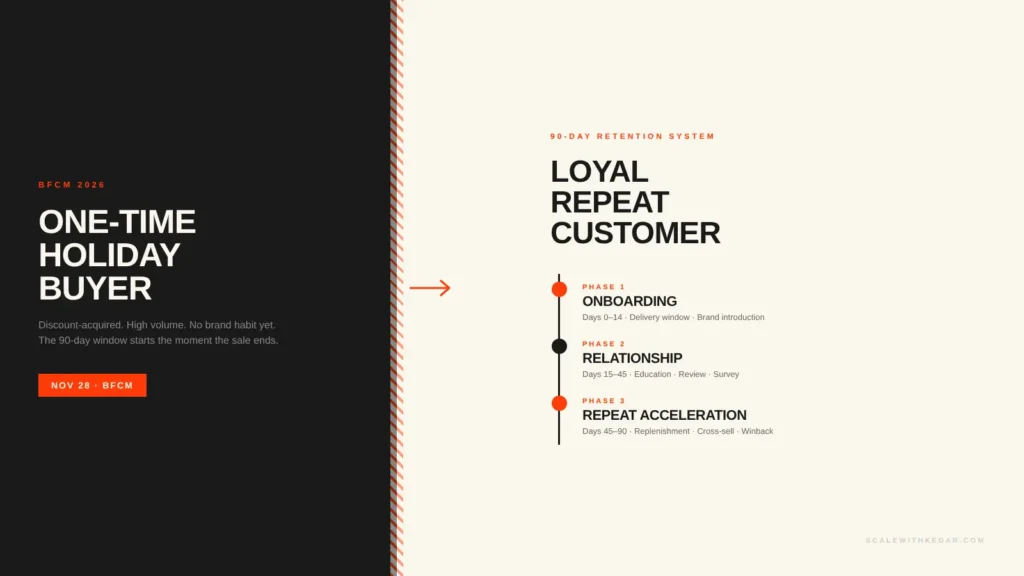
Split your lapsed segment into two tiers before you write a single line of copy: recently lapsed (1–1.5x their repurchase window) and deeply lapsed (1.5–3x). The messaging, offer, and channel mix will be meaningfully different for each.
Step 2: Build the Win-Back Email Sequence
The biggest mistake brands make is leading with a discount. You erode margin and train buyers to wait for deals. Start with a re-engagement hook, save the offer for later in the sequence.
A 4-Email Win-Back Structure That Works
- Email 1 — The “We noticed” email (Day 0): Acknowledge the gap. Feature recent launches, reformulations, or bestsellers. No discount yet. Subject lines like “Your last order was [X months] ago — here is what you missed” tend to outperform generic “We miss you” lines.
- Email 2 — Social proof drop (Day 4–6): Pull in recent customer reviews or UGC. Remind them why they bought in the first place. Address any objection that might be keeping them away — reformulation, new flavors, packaging upgrade.
- Email 3 — The offer (Day 10–12): Now introduce a reason to return. This does not always have to be a discount. Consider free shipping, a free sample add-on, or early access to a new product. If you use a discount, make it time-limited (5–7 days) and segment it by customer tier — high LTV customers get a better offer.
- Email 4 — Final call (Day 16–18): Short, direct, plain-text-style. “This is your last reminder” with the offer expiry. A plain-text format often performs better here because it feels personal rather than promotional.
For deeply lapsed contacts (2x+ their repurchase window), compress to a 2-email sequence: one relationship re-set and one final offer. Do not burn send volume on contacts who have gone cold for too long without a re-engagement signal first.
Step 3: Layer In SMS for Higher-Intent Contacts
SMS win-back works best for contacts who previously clicked or purchased through SMS — you already have implicit permission and behavioural signal. Do not blast your entire lapsed list via text; that is a compliance risk and a brand experience issue.
For opted-in lapsed SMS subscribers, a 2-touch SMS win-back running parallel to your email sequence can lift recovery rates by 15–25%, particularly on the offer email day. Tools like Postscript, Attentive, and Klaviyo SMS handle the sequencing and suppression logic if you set your segments correctly.
Keep SMS win-back messages short, human, and branded. “Hey [first name], it has been a while. Your favourite [product] is back in stock — grab 10% off before Sunday:” followed by a direct product URL with UTM tagging.

Step 4: Retarget Lapsed Buyers on Meta and Google
Not everyone on your email list is active. For lapsed contacts who are not opening emails, paid retargeting is often the only way to get back in front of them. Build a Custom Audience in Meta Ads Manager using your customer list — specifically the lapsed segment — and run a small-budget retention campaign with creative tailored to “come back” messaging rather than acquisition.
Key principles for DTC win-back paid media:
- Use a dedicated creative brief: Win-back creative is not acquisition creative. Lead with familiarity — “You tried us before” — not cold persuasion.
- Exclude recent purchasers and active email openers: You do not want to retarget people already engaging organically. Build exclusion lists carefully.
- Match offer to channel: If email gets a 10% discount, your Meta ad should match or the experience feels disjointed.
- Run a 14-day window: Win-back paid campaigns should be short and intentional. If someone does not convert in 14 days of ad exposure, move on or suppress to a lower-frequency audience.
For brands on Shopify, integrating your customer list sync to Meta via a server-side events connection gives you more accurate matching. Pair this with your Meta Ads ROAS optimisation playbook for a complete retention and acquisition media structure.
Step 5: Build a Sunset Protocol
Re-engagement has a point of diminishing returns. Contacts who have gone through your full win-back sequence with zero engagement — no opens, no clicks, no purchases — should be sunset rather than suppressed forever. Keeping them on your active list inflates list size, hurts deliverability, and skews analytics.
A clean sunset process:
- Send one final “Are you still interested?” email to deeply unengaged contacts before removing them from your main list
- Move non-responders to a suppressed or cold segment — do not hard delete if you may need the historical data
- Run sunset at 90-day intervals to keep your list healthy
- Report on list health metrics monthly: deliverability rate, open rate by segment, unsubscribe rate
A smaller, highly engaged list outperforms a bloated inactive one in email economics every time. Your Klaviyo or Attentive monthly cost is also list-size dependent, so sunset hygiene has a direct cost saving.
Metrics That Tell You If Your Win-Back Program Is Working
Most brands report on open rate and click rate, but for win-back campaigns the metrics that matter are different:
- Recovery rate: Percentage of lapsed contacts who placed an order within 30 days of entering the win-back flow. A reasonable target for recently lapsed contacts is 5–12%.
- Revenue per lapsed contact: Divide total win-back revenue by the number of contacts who entered the sequence. This is your ROI numerator.
- Cost of recovery: Include the discount or incentive value plus any paid media spend. Compare against the LTV of a recovered customer versus a cold acquisition.
- Subsequent repeat rate: What percentage of recovered customers buy again within 90 days? A win-back is only valuable if the buyer re-enters a normal purchase cycle.
Build a simple recovery dashboard inside GA4 or your Klaviyo reporting to track these monthly. Pair it with your DTC lifecycle marketing framework to see how win-back performance fits into your overall customer journey economics.
Win-Back Stack: Tools That Work for US DTC Brands
You do not need a complex tech stack to run effective win-back campaigns, but the right tools make sequencing, segmentation, and suppression significantly easier:
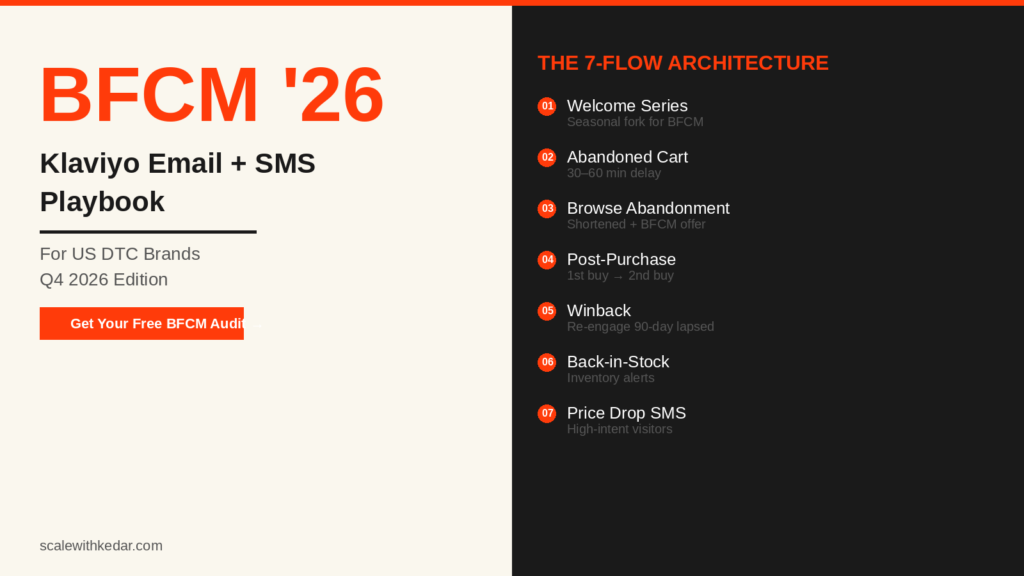
- Email: Klaviyo remains the standard for DTC email automation. Win-back flows are a native flow type with built-in suppression logic.
- SMS: Postscript or Attentive for SMS automation. Both integrate natively with Shopify and Klaviyo.
- Paid retargeting: Meta Ads Manager with a properly synced custom audience list. Google Ads Customer Match for search and YouTube intent layers.
- Analytics: Klaviyo’s built-in revenue attribution or a third-party tool like Triple Whale or Northbeam for cross-channel view.
Win-Back Is a Retention System, Not a One-Off Campaign
The brands that do win-back well treat it as a systematic, always-on flow — not something they turn on when revenue slows. Set it up once with clear segment triggers, review quarterly, and let the automation do the heavy lifting. The lapsed buyers already trust your brand enough to have bought once. Your job is to remind them why they did, and give them one good reason to come back.
If you want help auditing your current retention flows and building a win-back program tailored to your DTC brand, book a strategy session — the first conversation is free.